

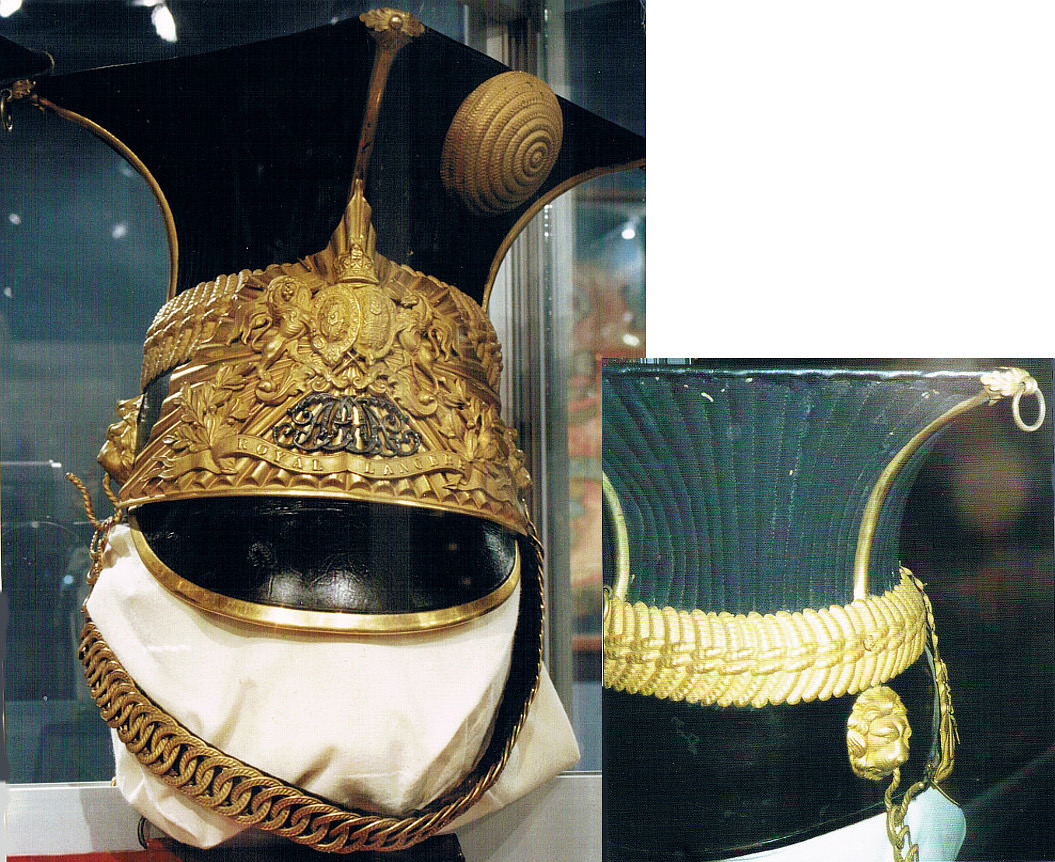
By the mid-1840s the lance cap had developed into a very impressive item of dress uniform. It was similar to the cap (czapka) introduced in 1831 but refined and altered. Whereas the earlier cap was all leather, this pattern had a blue cloth top half as can be seen in the back view, highlighted with flash photography.
The overall dimensions were as for the other lancer regiments, with the flat top of the cap being of black patent leather, and gilt metal ornaments on the top four corners. The right-hand corner had a ring for the cap line. The upper part of the cap was covered with blue ribbed cloth that fanned out towards the top, and the angles were covered with gilt strips.
On the left side of the upper part, a gilt metal coiled boss formed the base from which the black cock-tail plume extended. The skull, or lower part of the cap, was of black patent leather, with, around the waist, a two inch wide gilt metal band having the appearance of semi-circular rope with each double section bound together with another double rope. The source of this pattern is difficult to identify as it doesn’t relate to any aspect of the regiment or to the equipment of a lancer.
The front plate was a work of art made up of symbols associated with the reign of King William IV despite the fact that he had been dead since 1837, and Victoria had been Queen for the last 9 years. Adelaide’s cypher in silver was still retained by the regiment and continued to be their badge. The gilt chin-chain was lined with black leather and the leather peak which previously had been plain, was now edged with gilt metal.

