

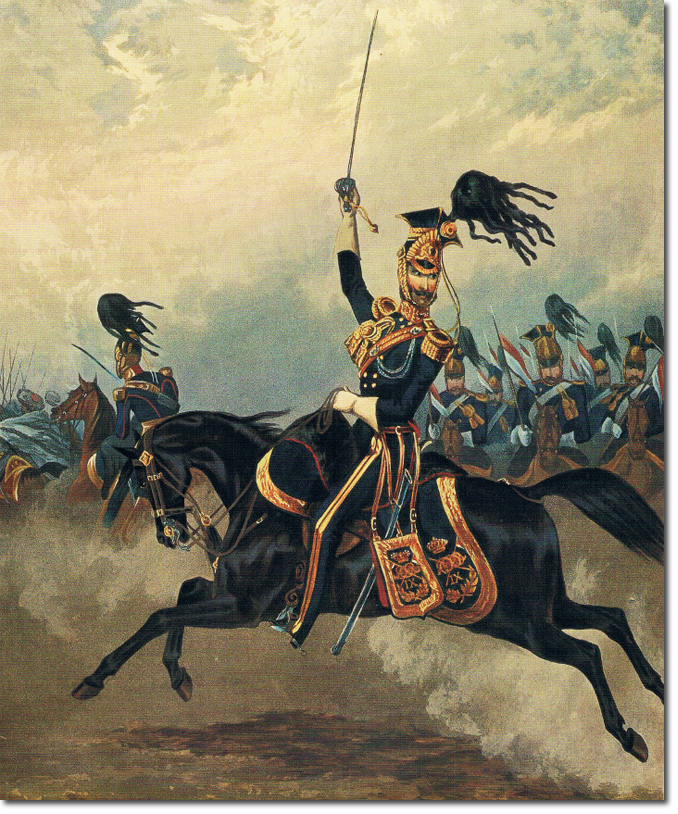
This fanciful print depicts the 9th Lancers in action against Maharattas (?). The scene was originally painted by Henry Daubrawa, engraved by John Harris and published by Ackermann on 20 Aug 1842. The officer in the foreground is in review order, immaculately turned out, fighting in India. The other ranks also look ready for a dress parade. The enemy can be seen retreating on the extreme left of the print. The reality was that the regiment set sail for India in May 1842 and disembarked at Fort William where they were infected with cholera. They marched to Cawnpore in the height of summer, losing 90 men from the disease.
But the artist had no knowledge of this and has attempted merely to illustrate the new uniform adopted by the 9th Lancers. The facings on the blue coatee were scarlet as was required for a Royal regiment. The regiment wore white gauntlets for parades but other images showing them in action without. The cuffs, hidden from view, were pointed. The change to pointed cuffs occurred in the 1830s when they were wearing red jackets, as the slashed flap and round cuff proved to be unpopular. The other changes made were the restoration of the gold bullion ‘waterfall’ at the back of the coatee, and the return of the piping up the back seams. When the change to blue jackets, or coatees, was ordered in March 1841 these features were retained. The officer on the left shows a back view, revealing the red piping on the back seams and sleeves.
The pouch-belt in this print follows the previous pattern i.e. Herringbone lace but with a central stripe of red instead of blue as before. The pouch, as seen on the officer in the background, is silver. This pouch and belt were short-lived, if indeed they existed, because the 9th adopted the all-gold pouch and belt in the early 1840s, and the artist may well have made a mistake. However, the horse furniture and sabretache agree with other sources; the regimental devices only on the rear of the shabraque, not the front, the black throat plume, and the design of the embroidery on the sabretache and shabraque all seem correct.

