

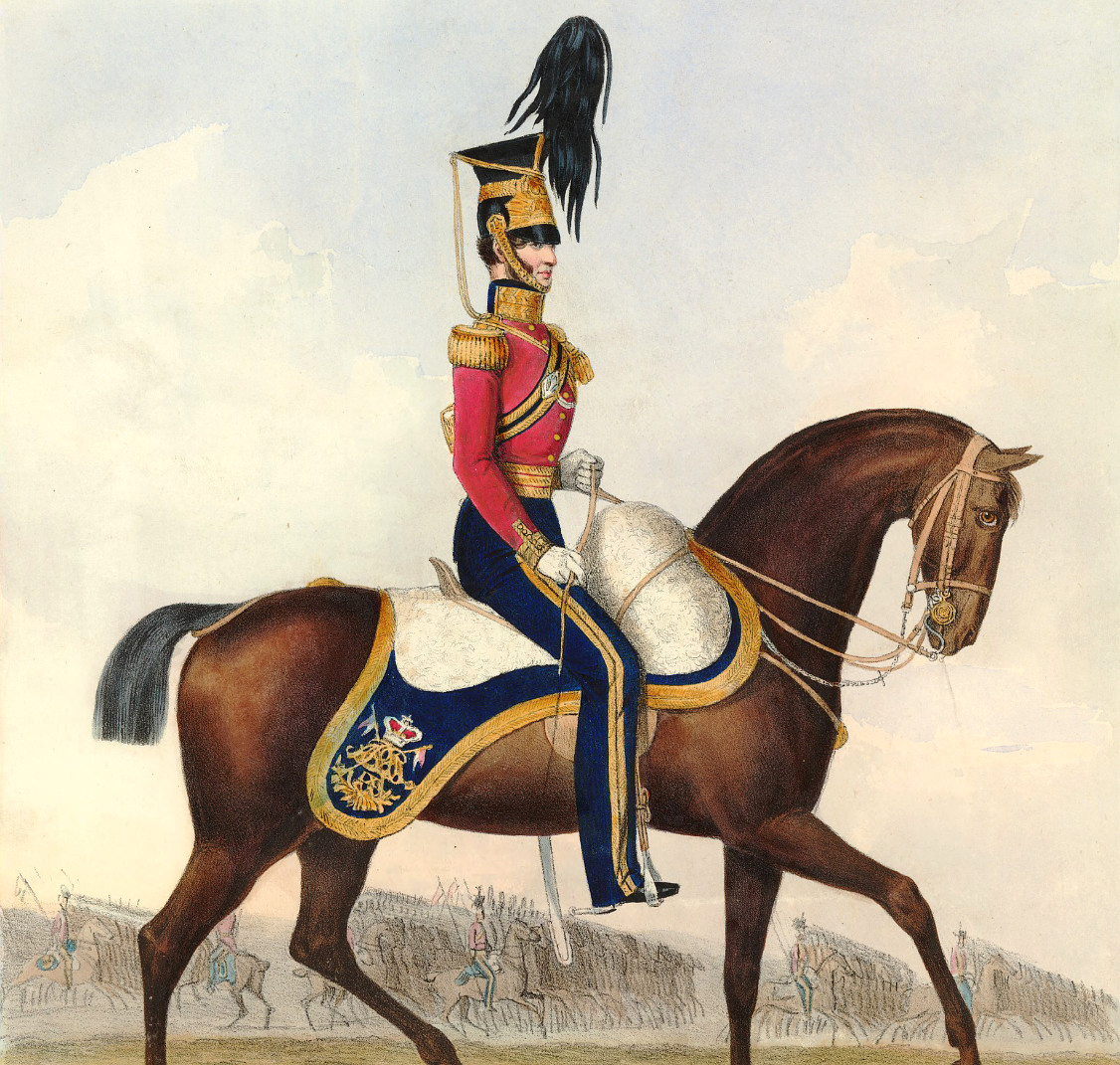
This print is numbered 55 in Spooner’s Upright Series series of 60 published between 1833 and 1836. They were carefully drawn by Mansion and Eschauzier, providing many accurate details. The embroidery on the collar and cuffs can be seen here, the collar being covered in gold at the front, leaving only a few inches of blue at the back. The slash flap on the cuff should be scarlet and the cuff itself blue, but the colourist has left them uncoloured. The 1834 Dress Regulations for officers specify five buttons on the slash flap which is drawn correctly here.
The pouch-belt is two inches wide, laced with a gold herringbone pattern that has a blue central silk stripe and blue edges. When the uniform was changed c1831 from blue to scarlet, the pouch-belt had to change from the previous pattern which had a crimson central stripe and edges. The silver pickers, chains etc. remained the same. The pouch itself is described in the DR as scarlet leather (with a solid silver flap), whereas the previous pattern was black leather.
The artist has omitted the waist-belt which supported the sword and sabretache. The belt and slings matched the pouch-belt, but the waist-belt was one and a quarter inches wide, fastening with a snake clasp. The two slings for the sword scabbard were one and a quarter inches wide, and the three sabretache slings one inch wide.
The gold epaulettes were ornate and expensive, heavily embroidered onto scarlet cloth and having a bright bullion fringe two and half inches deep. Later dress regulations stipulated different lengths of fringe according to rank but in the 1830s there was no difference between subalterns and captains. Majors and above had rank badges.
The lance cap is accurately drawn apart from the absence of the permanently turned up back peak. The cap-lines of plain gold cord are attached to the right-hand corner of the ‘trencher top’, but appear to have come from the other side of the cap. A double cord passes round the body from the right shoulder and ends on the left shoulder, hanging as flounders and tassels.
The horse furniture is carefully drawn, showing a very plain bridle compared with the ornately decorated straps of the latter part of the 1820s. The shabraque is blue with a herringbone pattern gold lace edge. Embroidery covers the rear corners but the 9th Lancers did not have any decoration on the front corners from c1830 to c1855.

