

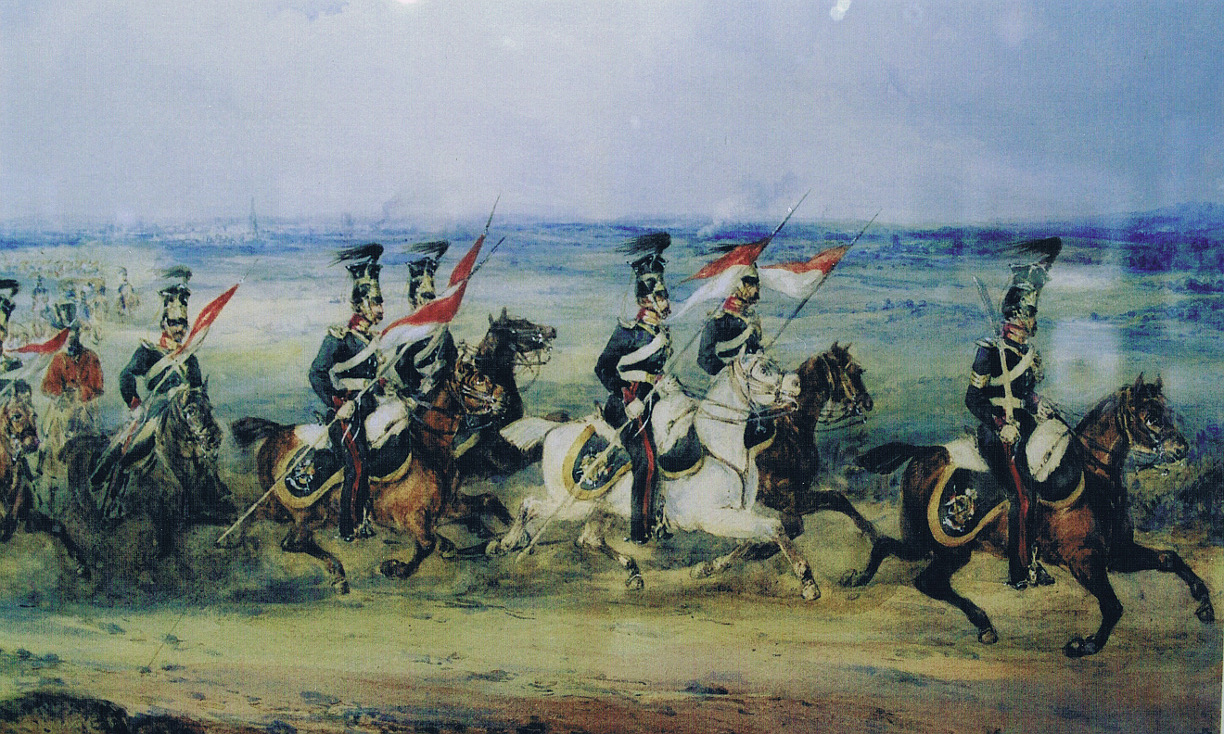
Six men of the 9th Lancers, under the command of a sergeant, canter ahead of a carriage, barely visible on the left of the picture. Behind this section rides a man in a red coat and top hat, an indication that the carriage has important, probably royal persons. The painting shows a city in the background with a tall cathedral spire. The painting is actually titled ‘Mounted Column, Salisbury Plain’. It was on sale at Tryon Gallery, 7 Bury Street, St James’s, London on 25 march 2003, the catalogue stating that the artist was Michael Angelo Hayes. This artist was best known for paintings and prints produced in the 1840s but it is my opinion that this painting is by Henry Martens and painted earlier.
The 9th Lancers wore blue uniforms with crimson facings until c1832, but when King William III came to the throne in 1830 he decreed that the army should be dressed in red, although the Royal Horse Guards (The Blues) were exempt from the order. The light dragoon regiments had worn blue since 1783, so when some of these units were converted to hussars and lancers they continued to wear blue. This painting shows the 9th wearing blue which means that it was painted either before the change to red, or after. The 1830 order took some time to come into effect as it would have taken time to prepare so many red uniforms.
The 9th Lancers wore red from some time after 1831, when the order was made for the change, and changed back to blue c1842. They sailed to India in May 1842 and stayed there until 1859 during which time they would have worn full dress only on rare occasions. It is generally believed that the regiment wore red jackets until the move to India but it is possible that they received the new blue jackets some months prior to embarkation. However, the new blue jackets had scarlet collars and cuffs to indicate the 9th’s royal status, whereas the blue jackets worn in the 1820s had crimson collars and cuffs. In this painting the red part of the pennons on their lances can be compared with the men’s collars and cuffs as evidence that they are wearing crimson.
The 9th Lancers were stationed near London in the early 1830s and were employed as escorts to King William and Queen Adelaide as they travelled around the country so this scene of the lancers preceding the royal carriage would have attracted the attention of an artist like Martens. The method of carrying the lance in this situation, as if ready for action, is of interest, as most paintings and prints show the lance planted in a small holder attached to the stirrup and looped around the arm. The sergeant does not carry a lance.
The men are in review order rather than marching order which means that they do not wear waterproof black oilskin covers on their lance caps. The lance cap is the new pattern introduced in 1831 which was a special pattern for the 9th, being all leather and having a metal band around the waist of the cap instead of coloured lace. And the front plate would have had Queen Adelaide’s cypher. The plume is black horsehair. The 9th adopted a broad white leather waist-belt at this time to replace the previous yellow and red striped girdle. The trousers have a double red stripe. The shabraque is embroidered on the rear part and the saddle is covered with a white sheepskin. There were some changes made in 1833 which included replacing the white sheepskin for black, although an eyewitness says that in 1836 they still had white. Another change of 1833 was that lancers should wear white gauntlets, further evidence that this scene is 1831 rather than 1842.

