

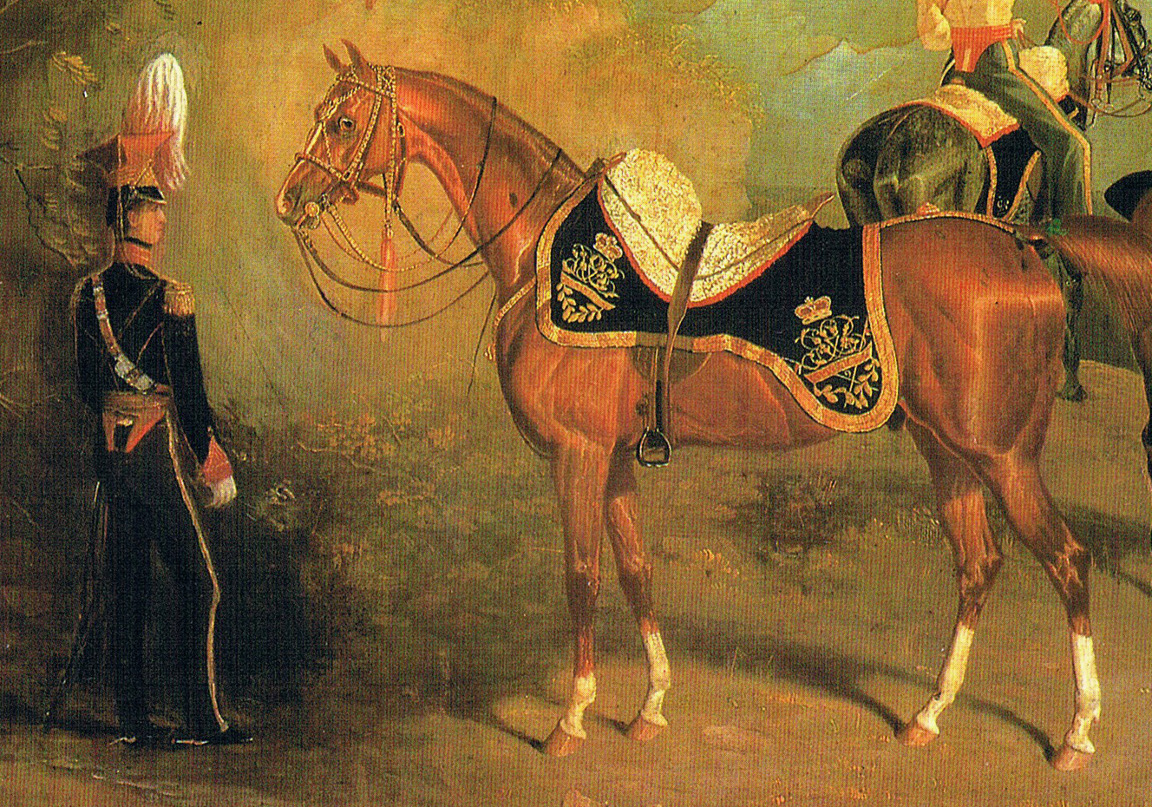
Captain Peter Burrell Williams stands with his charger in this detail from a painting that also includes a trumpeter and the Regimental Sergeant Major (shown separately). The painting is unsigned and undated but is thought to be by David Dalby of York, where the regiment was stationed from April 1827 until they moved to Hounslow in 1830. The painting was sold at Sothebys in July 1995 and described by W Y Carman in the Journal for Army Historical Research Vol 73 no.296 (Winter 1995).
Dalby has concentrated his skills on ‘Peninsula’ the chestnut charger (officer’s horses are called chargers) and lost interest when he came to paint Captain Williams, as the details of his uniform are uninspiring. The horse furniture is highly decorative and expensive. We know that all the officers were required to have the same tack and shabraque because the other portrait of an officer and charger c1826 shows the same items. The bridle, reins, breast collar and crupper are covered in brass or gilt. The latticed headstall or crown supports a red (or red and white) throat plume, and there are brass or gilt bosses on the charger’s face and on the crupper behind the saddle. The bit is also decorated with a boss.
The shabraque is dark blue, edged with herringbone pattern gold lace. It is embroidered on the two rear parts as well as the two front parts. An elaborate reversed GR cypher with crown above and PENINSULA on a red scroll below. The rear parts have crossed lances and 9 with leaves; the front parts have only the leaves. A white sheepskin with a red cloth edge covers the saddle.

