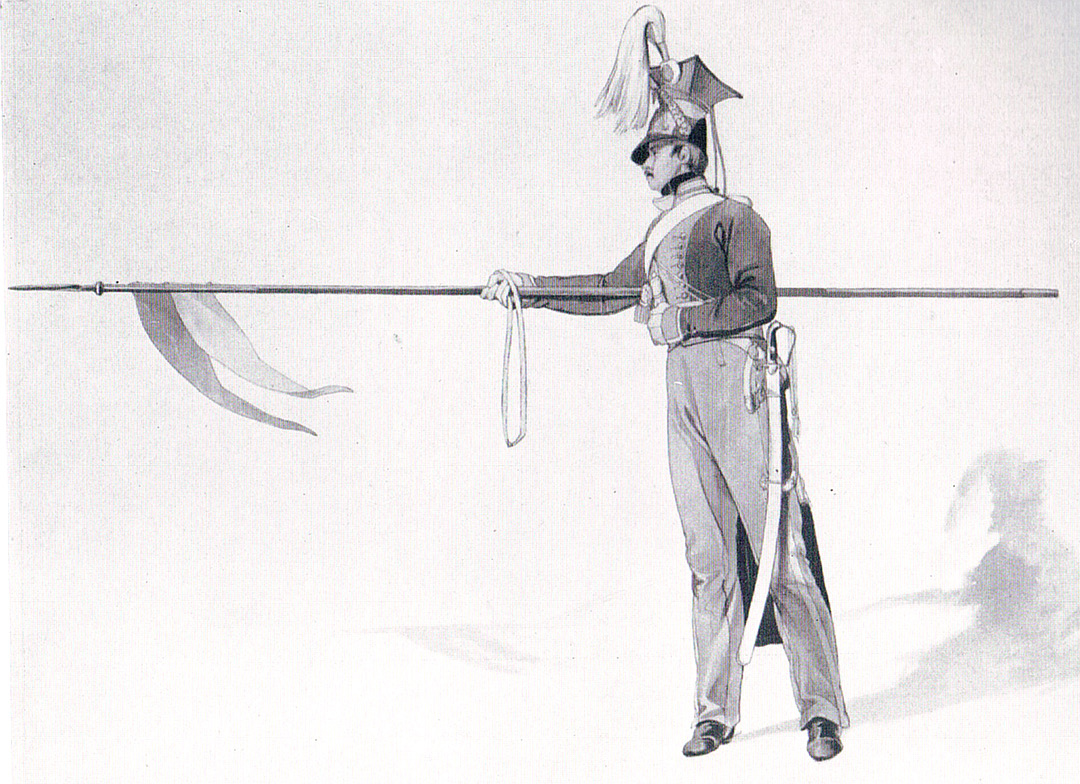
Other ranks were issued with the new lancer uniforms over the two years following the 1816 order for the 9th Light Dragoons to convert to Lancers. The jacket was not radically different from the light dragoon jacket that had been introduced in 1812, being blue with a crimson plastron front formed from the lapels being folded back. The jacket was fastened with hooks and eyes in this case, but the left lapel could be brought over to button up on the right side to make the body of the jacket appear all blue. The buttons in this painting can be seen to be placed close together, 7 visible, but one was placed to secure the top of the lapel, hidden by the pouch-belt, and one more hidden by the yellow and crimson waist-girdle. The collar was crimson with two yellow lace loops on each side, cut away at the front to show a white shirt frill and the uncomfortable black stock. The cuffs were crimson, edged with yellow lace, and had two small buttons on the underside where the cuff was split. White gauntlets were not worn at this stage, introduced c 1828. The back seams of the jacket and the back of the sleeves were piped with the facing colour, crimson, a custom in lancer regiments that continued for the next hundred years, at least. The shoulders were protected, or adorned, with brass shoulder scales, not clearly visible in this painting.
The headdress was a completely new piece of uniform for the British army. It was called a czapka, the Polish name for any form of cap, but it was more generally referred to as a lance-cap. The squared top half was covered with crimson cloth but the top itself was protected with a black waterproof layer. The lower part, or skull was of black leather, and a yellow and crimson striped tape covered the waist of the cap. The regimental plate on the front was of brass, and the chin-scales invariably shown as tied up above the plate. A yellow boss with a crimson centre was attached to the left front of the cap, near the top, from which the white and red horsehair plume protruded.
The loose-fitting trousers were light grey with a red stripe down the outside seams. This illustration gives a clear view of the 1796 light cavalry pattern sword, worn hooked up when dismounted, to the white leather belt concealed beneath the girdle. He also has a plain black leather sabretache slung from the same belt with two slings.
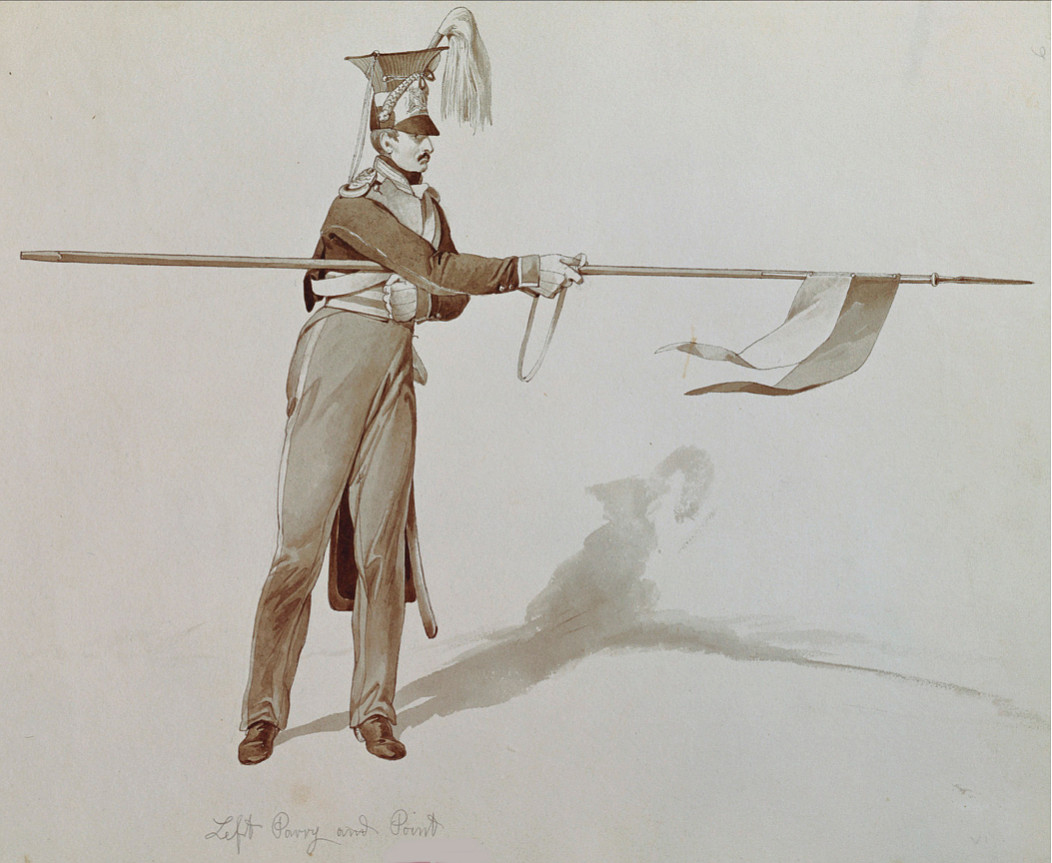
The painting, and the accompanying image below, were produced by Denis Dighton (and engraved by Richard Dighton) to illustrate the movements that the newly trained lancers had to learn. There are 25 of these paintings in monochrome pen and sepia wash, kept in the Royal Collection. The illustration below, not signed or dated, has the words ‘Left Parry and Point’ written below, and ‘First Division’ written in the bottom left corner (not shown here). This indicates that they were produced for Captain Peters’ course of lessons at the Riding Establishment at Pimlico. Peters’ method of training was called the Three Divisions.