

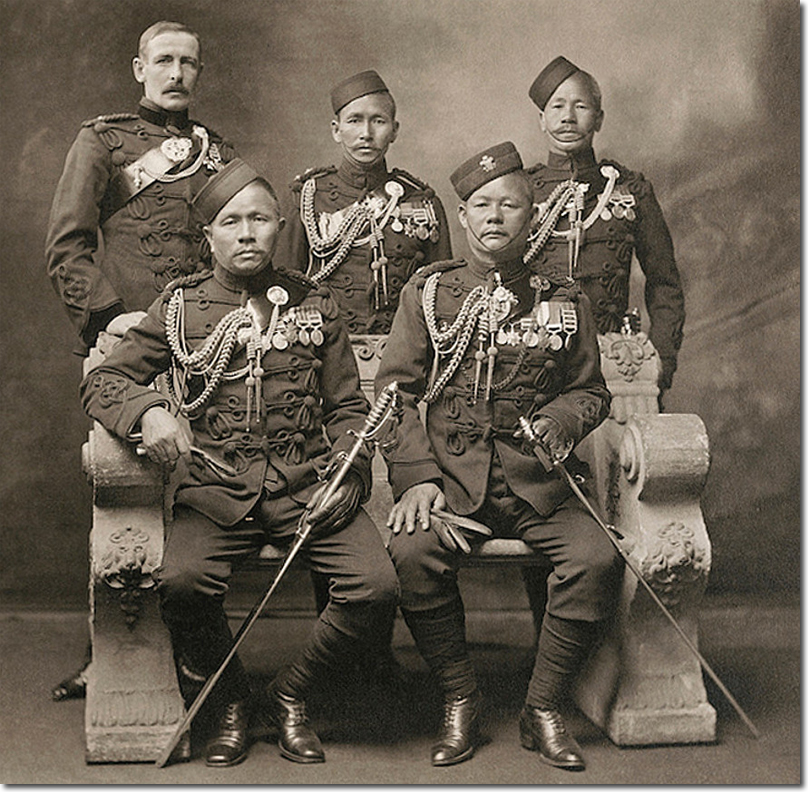
This photo is from the National Army Museum and shows Gurkha officers from five different regiments when they arrived in London to act as King’s Orderly Officers in 1905. The officers are named, confusingly, from the left:
Major A P Bateman-Champain, 2nd Bn 3rd GR
Subadar Major Karan Sing Gurung, 1st Bn GR
Subadar Kirpa Ram Thapa, 1st Bn 2nd (Prince of Wales’s Own) GR
Subadar Nawal Sing Rana, 8th Gurkha Rifles
Subadar Jas Lal Rai, 2nd Bn 10th GR
The belt plates are covered by the gold aiguillettes worn especially for the occasion to indicate their attendance on the King. This makes regimental identification difficult. The Subadar seated on the right is clearly 2nd (PoW) Gurkhas because of his cap badge, and just visible diced cap band. Major Bateman-Champain stands on the right without a helmet (or aiguillettes). One of the Gurkhas is a Subadar-Major and he can be identified because of an extra rank badge on his shoulder cords. He stands in the middle and we are told that he is from the ‘1st Battalion Gurkha Rifles’ although this must be a typing error as no regimental number is stated.
The muddled labelling means that Subadar Nawal Sing Rana of the 8th GR cannot be positively identified. From the parts of the belt plate that are visible it seems that he is most likely to be the man standing on the right. Two years after this photo was taken he was promoted to Subadar-Major, the highest rank that a native officer could reach, on 18 Mar 1907. He continued to hold the rank after September 1907 when the 8th and 7th Gurkhas became the 1st and 2nd Battalions of the new 8th, serving until the end of May 1912 when he retired. He was awarded the 1st Class Order of British India for his actions against the Abors in December 1911. He also received the Indian Order of Merit.

