

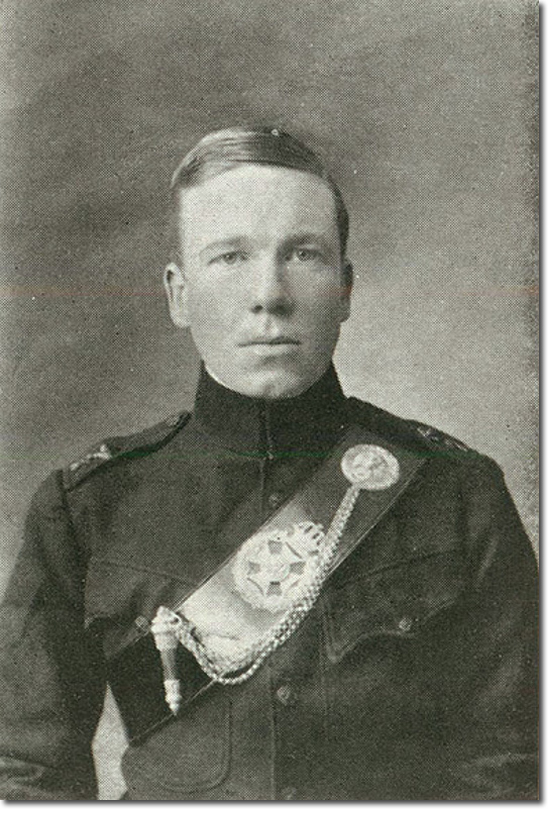
John Duncan Grant was born in India on 28 Dec 1877, the son of Colonel Suene Grant RE. He was educated at Cheltenham College and went to RMA Sandhurst. He joined the Indian Staff Corps and was appointed to the 44th Gurkha Rifles in 1900. In 1904 he went to Tibet with the 8th Gurkha Rifles, as the regiment was then titled, on the campaign in which he distinguished himself with a great act of bravery. At the storming of Gyantse on 6 July 1904, Lieutenant Grant led the storming company. On emerging from the cover of the village, he and his men had to approach the enemy up a bare, almost precipitous rock face with little or no cover available. They climbed under heavy fire from the curtain, flanking towers on both sides of the curtain, and other buildings higher up the Gyantse Jong. Showers of rock and stones were also being hurled at them. There was a breach in the curtain that could only be reached by one man at a time, climbing and crawling. Grant and Havildar Karbir Pun went first but were wounded and hurled back some 30 feet. They tried once more, despite their injuries, and under covering fire, managed to scale the breach and gain the top. This action inspired the regiment to renew their efforts and drive the Tibetans from their defensive position.
On 24 Jan 1905 he was gazetted to receive the Victoria Cross. Havildar Karbir Pun was not awarded the VC as, at that time, only British soldiers were eligible. Indian and Gurkha soldiers were awarded the Indian Order of Merit. Karbir Pun received the IOM First Class. Lt Grant was presented with his VC from King Edward VII on 24 July 1905, the last investiture by that monarch, and the last VC to be awarded before WW1.
Grant was promoted to captain in 1907 and in that year married Kathleen Freyer. They had two children, a boy and a girl. He served in New Zealand before returning to take part in the attempted relief of Kut in Mesopotamia. He also took part in the Third Afghan War in 1819 where he received the DSO. He left the 1st Battalion 8th Gurkhas, as it was then titled, on 1 Feb 1921 and transferred to the 10th Gurkha Rifles. He reached the rank of Colonel in 1926, at which time he was AAG Army HQ, India. He retired in 1929 and was invested in CB. He was appointed Colonel of the 10th Gurkhas in 1934 (until 1947) and served in the Home Guard in WW2. His final years were spent in a nursing home in Tunbridge Wells where he died in 1967. A plaque commemorates him in the Garden of Remembrance at Kent & Sussex Crematorium. His medals realised a price of 340,000 pounds at auction, purchased by the Ashcroft Trust and displayed in the Imperial War Museum.

