

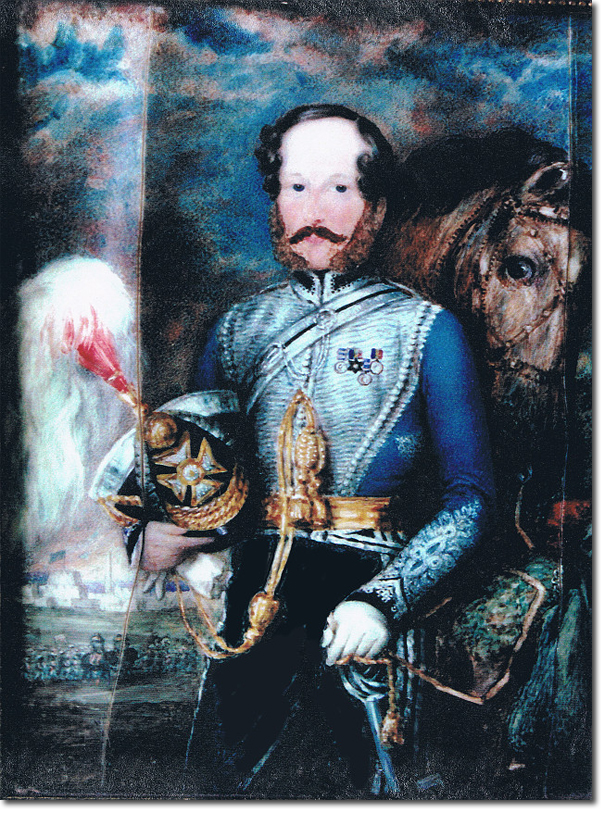
Thomas Lowth Harington was born in Reading on 27 Mar 1811. He was the 2nd son of Henry Hawes Harington of 35 Hans Place, Chelsea, formerly a Madras merchant. His mother was Martha Harington (née Nicholls), they had 5 children. His elder brother was Sir Henry Byng Harington who became a member of the Supreme Council.
Thomas was commissioned on 6 April 1827 and sent to the 3rd BLC on 4 Feb 1828. He was in the operations against the Kols in 1832 and then appointed interpreter and QM in the 3rd BLC on 6 Aug 1834. He transferred to the 5th Bengal Light Cavalry on 9 June 1836. He was on furlough from Jan 1838 to 28 Dec 1840 during which time he became a lieutenant and engaged to Emily Octavia Hall, getting married on 2 June 1840. They had nine children. On his return to India he was appointed Adjutant of the 5th on 17 Sep 1841. This appointment lasted until March 1843 and he continued as interpreter and QM until Jan 1846.
He served in the 1st Afghan War and was in Kabul and the action at Mamu Khel. He went on to the Gwalior campaign and was at Punniar on 29 Dec 1843. In the Sikh Wars he was at Sobraon, Chillianwallah and Goojerat. He was promoted to captain on 10 Feb 1846 and gained brevet rank for his services, brevet lieutenant-colonel on 20 June 1854. After the disbandment of the 5th BLC in 1857 he was a senior officer in the 5th Bengal European Light Cavalry. He went on furlough in 1858 and, with the rank of brevet Colonel, died suddenly on 6th April 1860, at Surbiton Hill.
The miniature portrait is signed illegibly ‘F.H.B…hoff’ and is very similar to the portrait of Charles Pager King of the 4th BLC. The distinctive uniform of the 5th BLC is very evident here, with black collar and cuffs on the light blue jacket, and the central black line on his belts. The other nine regiments of the Bengal cavalry were required to have orange facings. The medals on his chest look too small and very likely painted on later. The most recognisable is the Punniar star which is bronze with a silver centre. The other medals are for the 1st Sikh War (Sutlej Medal, Ribbon: dark blue with crimson edges) with a clasp for Sobraon, the 2nd Sikh War (Punjab Medal, Ribbon: dark blue with yellow stripe near each edge) with clasps for Chillianwallah and Goojerat. The right hand medal is for Cabool 1842 which normally had a rainbow watered ribbon but this looks like the Military Ribbon of India: crimson, yellow and blue.

