

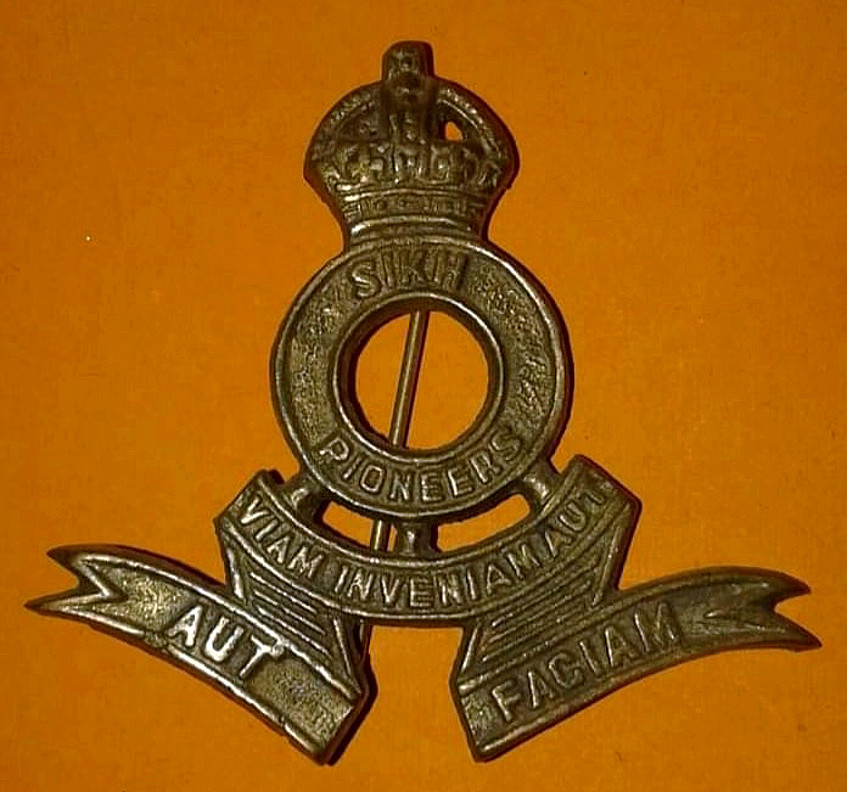
This short-lived badge was introduced in 1929 after reorganisation. At the end of the First World War, in 1922, all the Indian regiments were either amalgamated or renumbered. The three regiments of Sikh Pioneers — the 23rd, 32nd and 34th — became the 1st, 2nd and 3rd Battalions of the newly designated 3rd Sikh Pioneers, with an additional training battalion. The badge for this corps was intended to be the figure ‘3’ within a chakar (quoit) inscribed SIKH PIONEERS, with a King’s crown above and crossed axes below, together with the motto of the 32nd (dating from 1877): Aut viam inveniam aut faciam (“I shall either find a way or make one”). There is evidence, however, that the battalions retained their old regimental badges.
In 1929 the 3rd Sikh Pioneers was reduced to two active battalions and a Corps HQ. This badge was to be worn on the front of the turban or pagri. It has no number ‘3’ and no crossed axes. However, on 10 February 1933 the regiment was disbanded and the Mazbi and Ramdasia Sikhs were absorbed into the 3rd Bombay Sappers and Miners. The Jat Sikhs of the Bengali 1st KGO Sappers and Miners were unwilling to serve alongside the lower-caste Mazbis and Ramdasia Sikhs, so the attempt to place them in that Bengali unit had to be abandoned.
