

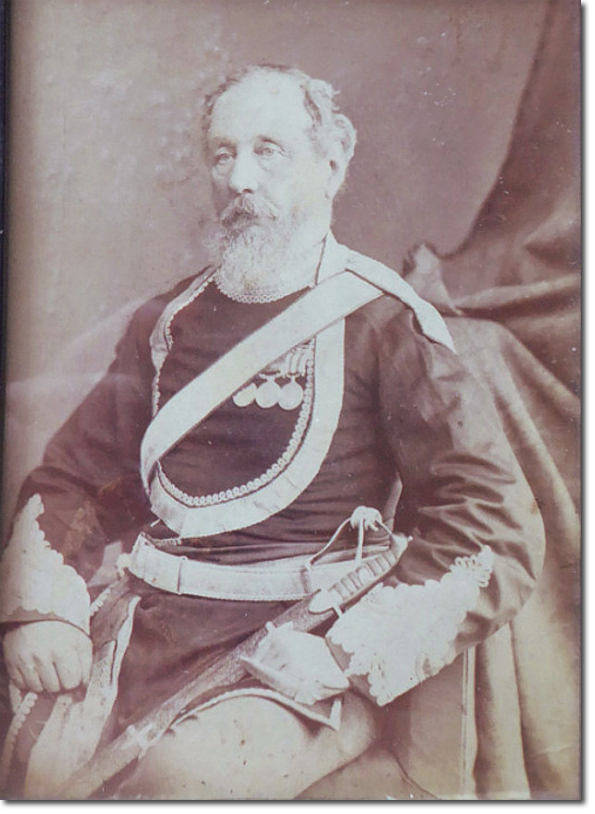
Colonel Jackson was a famous cavalry commander who held the post of commandant of Gardner’s Horse for 22 years. He was in command in the Second Sikh War and relinquished command in 1870.
George Jackson was born in Doncaster on 1 July 1812. His father was James Jackson JP, a banker and Alderman who was Mayor of Doncaster in 1803 and 1814. His mother was Henrietta, daughter of Freeman Bower JP and DL of Maltby Hall, Yorkshire. Seventeen-yr-old George went to India in early 1829 and was posted to the 3rd Bengal Light Cavalry, and in 1830 changed to the 4th BLC. He was promoted to lieutenant on 26 Mar 1838 and appointed acting Adjutant of the 4th in Sep 1839. However, the regular cavalry did not appeal to him so the rest of his career was spent as an officer in the Irregulars.
On 14 Aug 1840 he was acting 2nd in command of the 2nd Local Horse (Gardner’s) and on 18 Feb 1842 was transferred to the 7th Irregular Cavalry. However, he soon returned to the 2nd, as, on 14 April, he was appointed Adjutant of the 2nd Bengal Irregular Cavalry (as it was called from 1840). He was 2nd in command of the regiment on 11 July 1842 when they were operating in Bundelkhand. His appointment as Commandant was officially approved on 24 Feb 1848. His period of command covered the Second Sikh War of 1848-49, the operations on the North West Frontier against the Mohmands in 1851-52, and the Mutiny campaign in which he was wounded twice and saved from death by the bravery of four of his men. By 1866 he was a full Colonel, retiring as Commandant in 1870, and promoted to major-general on 1 Oct 1877. He reached the rank of General in 1889 but died in Sussex on 26 April 1889.
George was married to Phillis Sophia Strode, on 9 Feb 1829 at Karnal. They lived in retirement at St Helen’s, Preston near Brighton. The photo shows him wearing the alkalak of the 2nd Bengal Cavalry which, at the time of his retirement, was green with red facings and gold lace. In 1886 the 2nd changed to a blue uniform with light blue facings but he is more likely to be wearing the green uniform. He has three medals for the Second Sikh War, the operations against the Mohmands, and the Indian Mutiny. His sword is the 1796 Light Cavalry pattern.

