

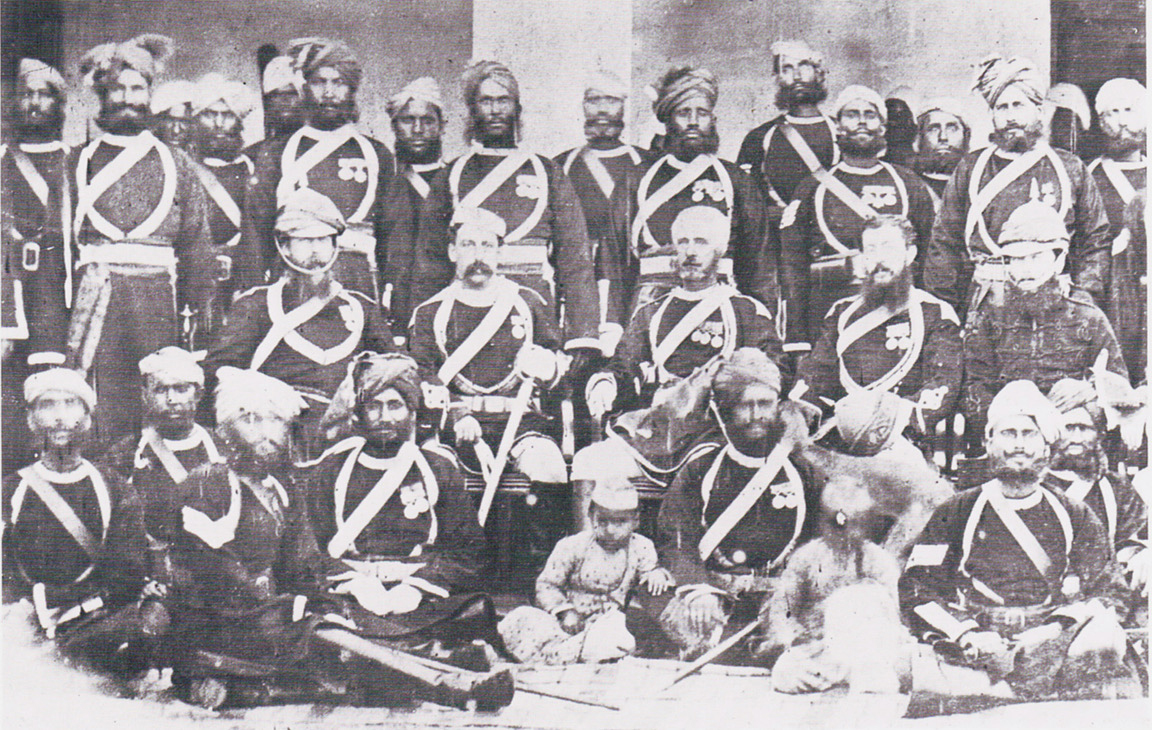
This group includes British and Indian officers, and NCOs, wearing their dress uniforms and medals. The white-haired officer with three medals is Lieutenant-Colonel Osborn Wilkinson. Other officers of the 2nd Bengal Cavalry who can be found in the 1874 army list are Major T C Graham, Captain C W Campbell, Capt F Knowles, Capt H C Kemble, Capt and Adjutant C E Salkeld, Capt C T M Higginson, Capt W B Craigie, and Surgeon Major F Parsons. The regiment was stationed at Segowlie and the uniforms are stated to be green with red facings and silver lace. They all wear alkalaks except for the officer seated on the right of the photo who is in a patrol jacket. The headdress for the British officers was a white, or light-coloured, helmet with a coloured pagri wrapped around.
One officer, without a beard, has a pill-box forage cap with a silver lace cap band. The visible cuff ornaments are the Austrian knots as worn in British regiments. As most of the officers are captains it would be expected that the silver Austrian knots would have Russia braid swirls all around, but they are not evident. Colonel Wilkinson’s cuff ornament is not visible but is probably the broad silver lace and braid worn by field officers of light dragoons and artillery, as seen in the photo of Colonel George Jackson in 1870. They wear buff breeches and black knee boots. Their silver laced pouch-belts do not have pickers and chains.
The Indian officers can be identified by the silver pouch-belt worn on the left shoulder. The NCOs have a leather sword-belt on their right shoulder. The officers do not have cuff ornaments like the British officers; their cuffs are edged with silver lace and have no apparent rank difference between risaldars and jemadars. Three senior NCOs have visible sleeve ranks. The most senior stands behind one of the British officers. He has four chevrons, his rank being kote-daffadar. A daffadar seated cross-legged at the front, on the right, has three chevrons and a vertical band of lace near the cuff. The kote-daffadar also seems to have this. It would be reasonable to assume that this was a distinction of senior NCOs, but the daffadar seated on the ground to the left of the photo does not have it. And to confuse the matter further, one of the Indian officers, standing behind the colonel has this sleeve ornament. The different types of headdress distinguished differing religions and classes of the Indian officers and rank-and-file.

