

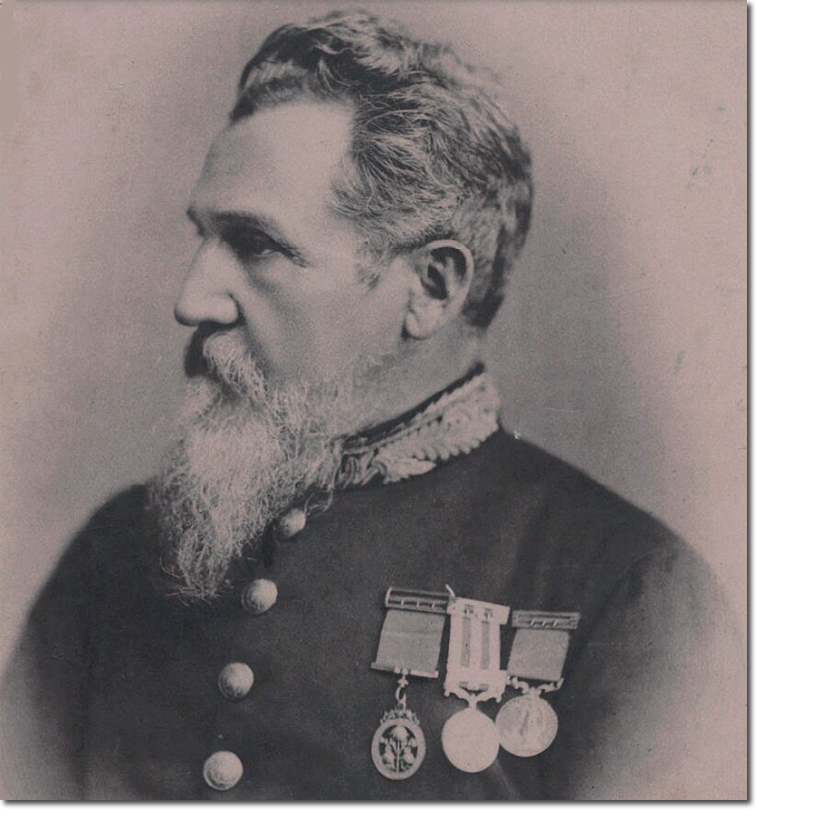
George St Patrick Lawrence was born in Ceylon on 17 Mar 1804. He was the elder brother of Sir Henry Lawrence, administrator of the Punjab. Their father was Lt-Colonel Alexander Lawrence who led the storming of Seringapatam in 1799. His mother, Catherine Letitia Knox was from Co Donegal. The family were Protestants originating from Ulster, and George was educated in Londonderry.
He went on to the military seminary at Addiscombe and was given a commission in the 2nd Bengal Cavalry, dated 15 Jan 1822. He was promoted to lieutenant on 1 May 1824 and appointed adjutant from 1825 to 1834. He fought in Afghanistan in 1839. He was appointed assistant and military secretary to Sir William Hay Macnaghten, envoy in Kabul. When Dost Mahomed surrendered he was placed in Lawrence’s charge until sent to Calcutta. When the violence broke out in Kabul, Macnaghten was slaughtered and George Lawrence became a hostage of the Afghans on 11 Dec 1841.
Lawrence remained behind when the British evacuated Kabul in January 1842, and was put in charge of the families. They were imprisoned by Akbar Khan until 17 Sep 1842. Lawrence remained captive but avoided execution by developing a relationship of mutual trust with Akbar Khan. On his release he suffered ill health and sailed to England in August 1843.
He returned to India in October 1846 and was appointed Assistant Political Agent in the Punjab, in charge of Rajputana. In 1847 he led 2,000 troops on campaign in the Swat Valley. His leadership retained the loyalty of his men when the Second Sikh War broke out in 1848, but they eventually went over to the enemy and George was again taken prisoner. After the war he was appointed by Henry to be deputy commissioner in Peshawar. He went on campaign again in November 1849, in General Bradshaw’s expedition into Yusufzai country. He also acted as guide to Sir Charles Napier’s column in the forcing of the Kohat Pass.
In July 1850 he was political Agent in Mewar, Rajputana, for 7 years. During the Indian Mutiny he commanded the forces in Rajputana and proved to be a steadying influence on the men. He saved the arsenal at Ajmer and helped prevent the mutiny of troops in Rajputana. He was also involved in quelling outbreaks of mutiny. For his services he was appointed CB in 1860 and promoted to major-general in 1861. In December 1864 he resigned his post in Rajputana and ended his 43-year career in India. In 1866 he was appointed Knight Commander of the Order of the Star of India (KCSI) and in 1867 he was given the honorary rank of lieutenant-general. He wrote ‘Reminiscences Forty-Three Years in India’ in retirement, published in 1875. Sir George Lawrence died at 20 Kensington Park Gardens, London on 16 November 1884, aged 80.
A letter written to Henry Daly by Lt William Anderson who, a few weeks later, was hacked to death in Multan in 1848, gives his view of the three Lawrence brothers, Henry, John and George. ‘All three brothers inspired hero-worship in their lieutenants…One kind of greatness is common to all the three brothers -- decision of character, unsurpassable and dauntless courage…George is brisk, jolly, less solid than John and the Colonel [Henry], but capable of great deeds in a crisis by his pluck, talent, honesty, and decision.’ Sir Charles Napier said of him, ‘He is a right good soldier and a right good fellow, and my opinion of him is high.’
The photo shows him wearing court levée dress. His medals include the CB, the Indian Mutiny Medal and the medal for Candahar, Ghuznee and Cabul 1841-42. He was also entitled to the Order of the Dooranee Empire which was awarded to him by Shah Soojah but the regalia were taken from him when he became a captive of Akhbar Khan.

