

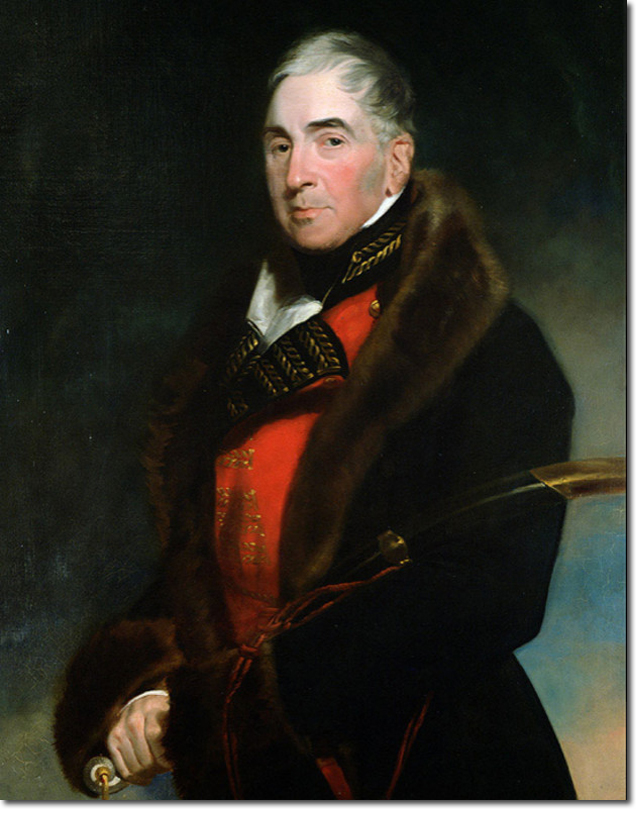
Thomas Graham was born on 19 Oct 1748. He was the son of Thomas Graeme of Balgowan, Perthshire, and Lady Christian Hope daughter of Charles Hope, the Earl of Hopetoun. He went to Oxford in 1766 and inherited the family estate when his father died in 1767. He spent several years on the continent where he learnt French German and Spanish. On his return to Scotland he managed the Lynedoch estate with great enthusiasm, building farmhouses and encouraging the cultivation of potatoes and turnips, and the breeding of farm animals.
His political career, beginning badly with an election defeat in 1772, was put on hold when in 1774 he courted and married the Hon Mary Cathcart, daughter of 9th Lord Cathcart. Unfortunately she died on 26 June 1792 on her way to France. At Toulouse, Graham was stopped by French soldiers who insisted on opening the coffin and searching under the body. This outraged Graham so much that he developed an instant and long-lasting deep hatred of the French. Her body was brought home and buried in a mausoleum built by Graham at Methven.
Graham devoted the rest of his life to a military career in order to fight the French. His first action was at Toulon in 1793 where he was ADC to Lord Mulgrave, and greatly distinguished himself. On 19 May 1794 he was ordered to raise the 90th Regiment (Perthshire Volunteers) which fought in the Quiberon expedition in 1795 and supported French Royalists in 1796. He temporarily left the regiment in 1796 to join the Austrians on the Rhine. He was with the besieged garrison of Mantua and undertook a dangerous 50 mile journey to the Austrian General Alvinzi. This involved a boat ride, long walks, wading through swamps, and dodging enemy pickets for 11 days.
He rejoined the regiment in Gibraltar in 1797 and was at the recapture of Minorca. The following year, as a brigadier-general, he commanded the 30th and 89th regiments in a two year siege of Malta, capturing it from the French and adding the island to the British Empire. His regiment, the 90th, had taken part in the campaign in Egypt in 1801 but Graham arrived too late for the battles. He went sight-seeing and made a memorable journey by horse from Constantinople to Vienna. Up until 1807 he spent time with the 90th in Ireland, and then spent 3 years in the West Indies.
He was part of the Corunna campaign and proved himself again in the arduous retreat, and was with Moore when he was mortally wounded. He was promoted to major-general and commanded a division at Walcheren. But when he contracted malaria he had to return home. His next venture was in Spain where he commanded British and Portuguese troops at Cadiz as a lieutenant general. On 5 Mar 1811 he observed Spanish forces abandoning Barrosa Hill and immediately ordered an attack on the French who were about to capture it. This action was a brilliant success and ensured Graham’s reputation as one of the finest commanders in the army. He was appointed 2nd-in-command to Wellington and proved himself again at Ciudad Rodrigo in 1812. But he suffered from eye trouble and had to be sent home.
On his return to Spain he fought at Vittoria and then at San Sebastian which was a scene of horror when the British killed and raped in a week-long drunken rampage. After the army entered France his health deteriorated and he again returned home. His last military venture was in the Netherlands where he led the British attack on Bergen op Zoom on 8 Mar 1814 but the battle ended in failure.
On 3 May 1814 he was created Baron Lynedoch of Balgowan. As well as a military career, Graham, as a member of the gentry, played an active part in politics. He was supported by the Duke of Atholl who helped him gain a seat in Parliament as MP for Perth, in 1794 until 1800 and then again in 1801 until 1807. He was promoted to General in 1821 and appointed to be Colonel of the 58th in 1823 and the 14th in 1826. On 12 Dec 1834 he exchanged to the colonelcy of the 1st Royal Regiment.
He retained good health in old age, travelling abroad, as far as Russia, and in 1841, at the age of 93, he travelled through France to Genoa and Rome on horseback. However, on 18 Dec 1843 he got up and dressed himself at his London home in Stratton Street, but fell ill and died. He was buried alongside his wife Mary in a large specially built, rather ugly stone vault in Methven churchyard.

