

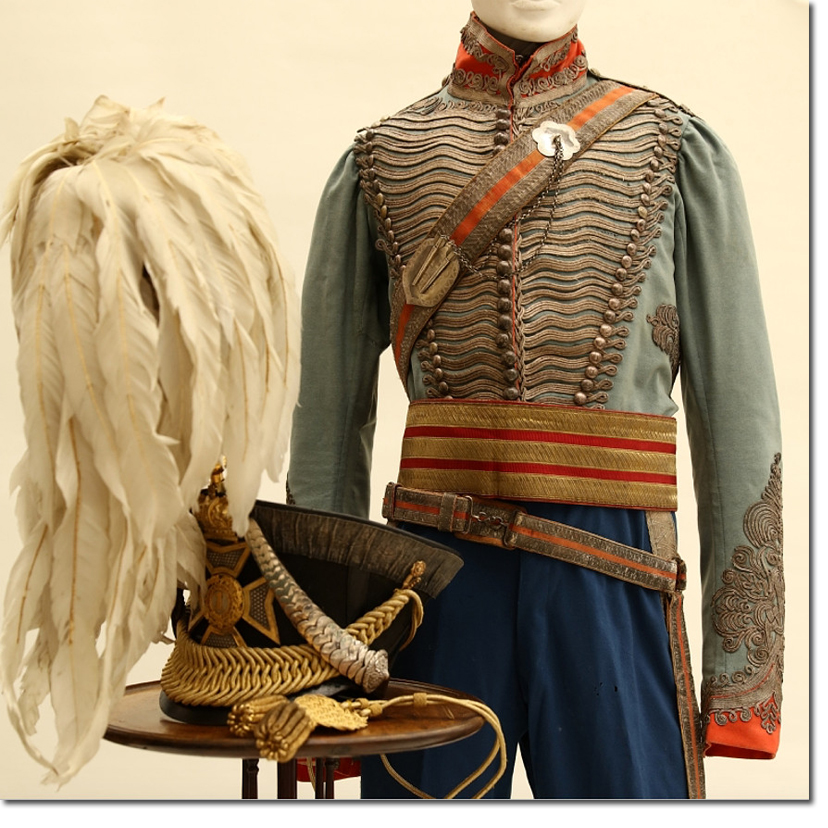
By the 1830s the officers’ dress uniform had developed to this pattern which was popular in Indian cavalry and horse artillery regiments. The braiding across the chest is wavy, linking three vertical rows of silver buttons. Each button is marked with a 1 and the battle honour LESWAREE. The collar and cuffs are of orange scarlet colour, and elaborately decorated with silver braid and silver half-inch lace. The collar is high, and the space on the shoulders between the button loops and the collar is partially filled with ornamental braiding.
The dress pouch-belt is of silver lace with a broad central stripe of orange. It has silver chains and pickers in light dragoon pattern, and there is a silver fronted pouch on the back, and silver buckle, slide and tip. Around his waist is a girdle of gold lace and red between the lace. The sword and sabretache are suspended from a waist-belt of similar pattern to the pouch-belt. His trousers are mid blue with a single silver stripe one and three quarter inches wide. Breeches and boots had ceased to be worn c1825.
On the table is his bell-topped shako of black beaver with a silver oak-leaf pattern lace band around the top. The front is ornamented with a Maltese cross and Victorian gilt crown. The gold cap-lines form a plaited festoon on the plain leather peak. The other end of the lines have elaborate flounders and bullion tassels. Silver chin-scales attached to floriated bosses are tied up to the top of the cap. The white cock feathers form an impressive finish to this outfit. The photo comes from the Military Gentleman website.

