

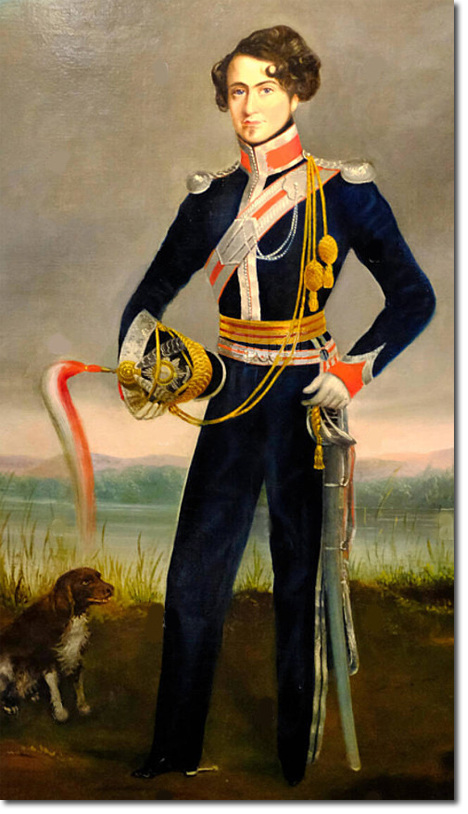
This uniform appears to be too smart to classify as undress but the jacket is devoid of the elaborate silver braid that covered the chest and forearms of the dress jacket. The plain dark blue jacket was edged with silver lace, and on the collar and cuffs. It fastened with hooks and eyes but had small closely placed silver balls sewn down the front edge. This was also worn open as a mess jacket. On the shoulders were ornate silver scales. In 1836 this dark blue jacket was replaced by a French grey undress jacket of similar pattern.
The rest of the uniform was the same as worn in dress, a silver and scarlet/orange pouch-belt, a gold and crimson waist girdle, silver and scarlet/orange sword belt and sabretache. The dark blue trousers have a double silver stripe. In his hand is the dress shako with the first pattern shako plate in the shape of a silver star with central gilt circle and a number 1. This was replaced a year later with the Maltese cross pattern shako plate. The oak-leaf pattern lace around the top is silver but the cap-lines are gold, finishing up as a plaited festoon above the peak. The plume is a red and white horsehair; in dress uniform this would have been drooping feathers.
The portrait, painted by Rajah Sansome, is of Lieutenant James Irving who joined the regiment in March 1829 at the age of 22. He fought in the 1st Afghan War and the 2nd Sikh War. His Punjab medal is kept at the National Army Museum, having clasps for CHILIANWALA and GOOJERAT.

