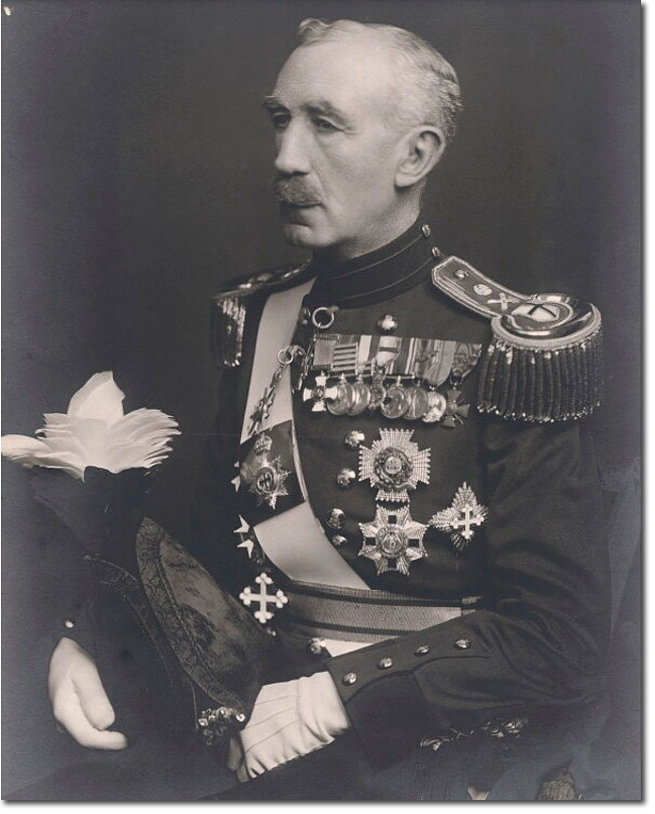
Charles Kavanagh was born at Borris, Co. Carlow on 26 Mar 1854, the son of the Rt. Hon Arthur McMurrough Kavanagh. He was educated at Elstree then went on to Harrow and trained at Sandhurst from 1882. He entered the 10th Hussars on 6 Feb 1884. In 1889 he was sent out to Jamaica as ADC to the Governor. He returned in 1890 to gain the rank of captain on 1 Feb, in command of a Troop. In1895 he was married to May Perry from Tipperary and seconded to the Leicestershire and Derbyshire Yeomanry as adjutant. He returned to the 10th in 1900 while they were serving in South Africa. He was given command of C Squadron, and then in 1901 he was in command of a mobile column. He pursued General Smuts vigourously, as confirmed by Smuts himself, who, after the war stated that Major Kavanagh came closer to catching him than anyone else. His men nick-named him Major Push-Along. He was awarded the DSO for his services in that war.
In 1902 he was second in command of the 10th Hussars, to Lord Byng, when they went to India. He played polo for the regiment while there. In 1904 he was appointed commanding officer, up until 1908. He was promoted to Colonel and in 1909 succeeded Lord Byng as commander of 1st Cavalry Brigade at Aldershot. In Dec 1913 he commanded the Fyzabad Brigade in India until war broke out, which happened to be while he was on leave in England. He went with the BEF to Flanders where he was put in charge of 7th Cavalry Brigade. In the Battle of Ypres his leadership skills brought the brigade to a high level of efficiency. On 6 Nov he led a counter attack which many considered to have saved Ypres and the British Army. He was promoted to major-general in Jan 1915.
In April 1915 he was commanding the 2nd Cavalry Division and was prominent in the Second Battle of Ypres, and from July 1915 to March 1916 was with the 5th Division. They held a very large sector north of the Somme but the general was usually in the front line trenches ensuring the well-being of the men as far as possible, and getting around to all parts of the sector. From March to July 1916 he was in command of the First Corps at La Bruissiere. Again he was constantly on the move, visiting the trenches but this time upsetting Divisional Generals with his ‘interference’.
In August 1916 he was asked to re-form the Cavalry Corps and commanded the five Divisions until the end of the war. He led them in the successful Battle of Amiens, and into Cologne. For his efforts was created a KCB in 1917 and KCMG in 1919. He retired from the army after the war and settled down at Morritown Bellar, Newbridge, hoping to breed horses, but this was unsuccessful so he took to finance for which he went to China in 1922, but again without success. His next venture was in the Stock Exchange which proved more fruitful. The National Portrait Gallery has a photo of General Kavanagh dated 1933 that shows him wearing the uniform of the Governor of the Military Knights of Windsor (see below) . He and his wife Mary had two daughters. He died on 11 October 1950.