|
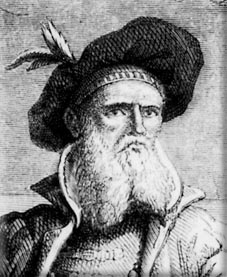
John Cabot (about 1450-98) was an experienced Italian seafarer who came to live in England during the reign of Henry VII. Probably born in Genoa around 1450, and later a citizen of Venice, Cabot's Italian name was Giovanni Caboto. He had read of fabulous Chinese cities in the writings of Marco Polo and wanted to find a route to Asia for himself. He hoped to reach them by sailing west, across the Atlantic.
Like Christopher Columbus, who also planned to sail west, Cabot found it very difficult to convince rich backers to pay for the ships he needed to test out his ideas about the world. After failing to persuade the royal courts of Europe, he decided to come to England. He arrived with his family in 1484, to try to persuade merchants in Bristol to pay for his planned voyage. However, before his voyage set off, Cabot heard the news that Columbus had sailed west across the Atlantic and reached land. At the time, everyone believed that had arrived in the Indies, or Spice Islands.
With the Columbus' voyages causing a sensation in Europe, Henry VII decided to give this determined mariner an opportunity to find a route for England to the riches of the East. Henry declared: 'The king wrote that he gave his permission to his
well-beloved John Cabot... to seeke out, discover and finde whatsoever isles, countries, regions or provinces... which before this time have been unknown to all Christians.'
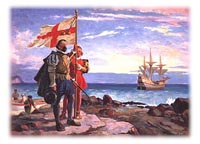
John Cabot's ship, the Mathew, sailed from Bristol with a crew of eighteen in 1497. After a month at sea, he landed and took the area in the name of King Henry VII. Instead of China or Japan, he found the barren rock-ribbed coast
of Cape Breton Island, off the coast of
Canada. In further voyages his record
was no better: unfriendly sightings of
Greenland, Labrador, Newfoundland and
New England. He brought back furs, a wild cat and some eskimos as curiosities to the court of Henry and tales of fantastic fish-banks off the coast of Newfoundland. Cabot was rewarded with the sum of #10 by the king, for discovering a new island off the coast of China! It is not sure if he meant to call it Newfoundland, or whether he just referred to it as newe founde land in his journal.
In 1498, John Cabot was given permission by Henry VII to take ships on a new expedition to continue west from the point he had reached on his first voyage. The aim once again was to discover Japan. He set out from Bristol with 300 men in May 1498. The five ships carried supplies for a year's travelling. Cabot and his crews were never heard of again.
|