|
by Lacey Baldwin Smith
|
|
"Whosoever commands the
sea commands the trade;
whosoever commands the
trade of the world commands
the riches of the
world, and consequently the world itself."
The formula was first voiced by
Sir Walter Raleigh but it had been fully
understood by Spanish and Portuguese
mariners long before the visionary Elizabethan
poet-cum-adventurer sought to
captivate his countrymen with the dream
of world Empire. Englishmen were latecomers
to the sea that lapped their island
kingdom. Iberian merchants, not London
shopkeepers, had first responded to the
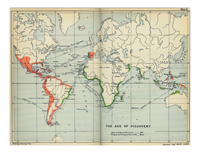
three historic voyages by Columbus, da
Gama and Magellan that between 1492
and 1519 revolutionized men's minds and
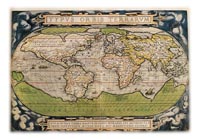
changed their ideas about the earth, geographically
enlarging its circumference
by 5,000 miles and revealing the New
World of the Americas. The "green sea
of darkness" which had been western
Europe's prison was transformed into a
high-road for expansion, and the seaports
of the Atlantic became windows to the
Far East as shipwright and navigator
set about testing what the poets had
dreamed of: a sea-route to Cathay - as
China was known - and its fabled
wealth, described by Marco Polo two
centuries before.
But the New World, rich in gold and
politically ripe for the picking, which
thrust itself between the Iberian harbours
and the wealth of the East Indies
proved to be a greater attraction than
the legendary Ming Treasury. Spain and
Portugal proceeded to carve up the
newly discovered lands between them.
Once started, Iberian expansion,
heavily fortified by technological superiority
in ships, guns and political organization,
could not be stemmed. Within a
decade Portugal had turned the Indian
Ocean into a private lake and the Malabar
coast into a closed trading preserve. Territorial
expansion took Spain slightly
longer. Not until the I540s was the New
World safe for commercial and cultural
exploitation by Seville merchants and
Andalusian priests, but from the start
both kingdoms perceived the magnitude
of their discoveries and called upon an
obliging Deity to safeguard their economic
monopoly and sanction their
military conquests.
In 1494 His Holiness the Pope was persuaded
in the Treaty of Tordesillas to
exercise his divine mandate and apportion
the world between those most
Catholic sovereigns, Ferdinand and
Isabella of Spain and John II of Portugal
on a line 1,000 miles west of the Azores.
To the Iberian, it was obvious that the
Lord, considerably aided by Albuquerque,
Balboa, Cortes, Pizarro and the other
conquistadores, had always intended that
neither the New World nor the South West
Passage to Cathay should be plagued
by Northerners, be they English, French
or Dutch. Spaniards and Portuguese
calmly accepted that the profits of world
empire belonged to them - "so Catholic,
so firm, so true."
Until the mid-I6th Century, the Spanish
and Portuguese seemed to have nothing
to fear from the English, at least. For
they, in the words of the great historian
of exploration, Richard Hakluyt, were
traditionally known "for their sluggish
security," a people who, despite their
insular location, were strangely blind to
the wonders of the deep. The lure of the
nautical unknown, of the pot of gold to be
found just over the horizon, which persuaded
Spaniards by the thousand to
undertake their hazardous voyages, exercised
no such magic in the North.
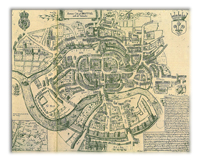
The one man in England who was
caught up in the dream of discovery was
not even a native, but a Venetian merchant
who had settled in Bristol. In 1497,
two months before da Gama set out on the
journey that took him from Lisbon to
Calicut, John Cabot sailed west in search
of the lands of the Dragon Throne. What
he found was the barren rock-ribbed coast
of Cape Breton Island, off the coast of
Canada. In further voyages his record
was no better: unfriendly sightings of
Greenland, Labrador, Newfoundland and
New England, a wild-cat and a brace of barbaric Eskimos brought back to London
as curiosities; but no Asia and no civilization
rich in gold and spices. Only an
oddity proved significant. Off the Newfoundland
Banks was discovered a portion
of the sea where the fish were so plentiful
that they could be pulled in by the
basketful, without net or hook. Henry VII
commissioned all of Cabot's voyages
but the only official document left of
the first is a note of "10 pounds for him
that found the New Isle," and thenceforth
Bristol merchants were content to
concentrate on the safer and more profitable
business of supervising their cloth
exports to Antwerp, Calais. and Cadiz.
 |
|
|
On the surface it may seem surprising that
Englishmen did not go down to
the sea in ships, and that
Columbus's recital of the wonders
he had found - "the greatest
event since the creation of the world" did
not fire the Anglo-Saxon mind. The
island kingdom was more politically unified
than Spain, was larger in population
than Portugal, and early Tudor sovereigns
were just as interested in ships and trade
as John II of Portugal or Ferdinand and
Isabella of Spain. Henry VII possessed a
highly developed appreciation for the
importance of commerce, and his son
was absorbed by shipbuilding and naval
architecture.
Henry VIII, like his father, was not
unreceptive to the possibility of new
markets for English wool, and during
the 1520s he backed a number of abortive
efforts to discover a North-West Passage
which would bring China within reach of
London merchants. Leadership, motive
and economic means were all there, but
except for a handful of dreamers, Englishmen
were content to remain in their
chimney-corners, and Robert Thorne's
impassioned Declaration to Bluff King
Hal was never heard: "With a small
number of ships there may be discovered
divers new lands... in which without
doubt your Grace shall win perpetual
glory and your subjects infinite profit."
There were plenty of seamen who
doubted that the Deity had reserved the
New World for Spain and Portugal.
There were even a few who ardently
believed that the North, its lands and its passage to the East, had been set
aside by Divine Providence to be discovered
by Englishmen; but time and
circumstance were not yet right. The
kingdom's political efforts during most of
Henry VIII's reign were still directed
towards the slaying of a medieval dragon
- the conquest of the lost provinces of
France. Economic energy remained landlocked
in raising sheep, carding wool,
weaving cloth and mining tin. European
merchants beat a path to English ports;
there was no need to search further afield
for new markets or for English navigators
to chart the currents of the Channel, let
alone the Baltic or South Atlantic.
Spiritual drive, at least for the time being,
was also turned inward, as the King's
matrimonial affairs dragged the realm
into religious schism. Divine Providence
had plenty to do in keeping the island
safe for Protestantism without reserving
the North-West Passage for English
commercial penetration.
 |
|
|
Within a generation, as the Elizabethan
era took shape, apathy turned
into unprecedented naval daring. Political,
economic and religious dynamism
coalesced and turned outward, producing
a breed of adventurers just as ruthless,
just as greedy, just as spiritually arrogant
as any conquistador. In part the metamorphosis
was simply the product of
malice - why should Spain and Portugal
harvest the riches of the East and West?
In part it was an offshoot of Protestant zeal - surely the Lord had not intended
the entire earth to be Catholic? In part it
stemmed from the spectre of economic
ruin as the wool trade moved from boom
to bust; and in part the transformation
was itself an hallucination, a marvellous
affliction of the mind which turned the
horrors of ocean travel into the romance
of discovery. Whatever the explanation,
it was not long before Elizabeth's brave
seafarers were setting out "to seek new
worlds, for gold; for praise, for glory."
The underlying emotional change is
impossible to date; the economic inspiration,
however, can be precisely
isolated. In 1550 the English wool industry
faced disaster as export figures
fell by 35 per cent. Confronted with
bulging warehouses and constricted by
the privileges still retained by the continental
traders of the moribund Hanseatic
League, London merchants looked
over the top of the world to the Orient,
where even in the 16th Century it was
argued that China's teeming millions
would be England's economic salvation.
As Hakluyt put it, "our chief desire is
to find out ample vent of our woolen
cloth, the natural commodity of this
our Realm," and the fittest places were
the manifold islands of Japan and the
northern parts of China...."
 |
|
|
The economic remedy was apparent;
the proper path was not so easily discerned:
some favouring the north-west,
others the north-east route to Cathay. Beginning half a century before, the
Cabots - both Sebastian and his father
John - discovered on a series of
voyages that took Sebastian as far north
as Hudson Bay that the westward route
consisted of endless miles of icy water and
smothering fog. The experts, therefore,
favoured the opposite direction: north
into the Norwegian Sea, east round the
North Cape of Norway into Barents Sea,
and then, the geographers predicted, a
warmer trip into temperate waters down
the northern coast of China.
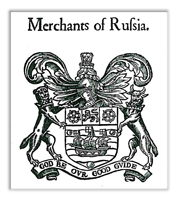
Realizing that no single individual
had either the economic means to risk
such a venture or the international
prestige to impress the Celestial Court of
China, London merchants then joined
under royal patent to form a joint-stock
company. Sebastian Cabot was elected
first Governor and the new enterprise
was given the optimistic name of the
"Company of Merchant Adventurers of
England for the Discovery of Lands
Unknown."
"Unknown" was indeed the operative
word, for instead of finding the Son of
Heaven the explorers ran across Ivan
the Terrible of Russia. Three vessels set
out in May, 1553, under the command of
Sir Hugh Willoughby with "the incomparable
Richard Chancellor" as Chief
Pilot, on an expedition possible only in
theory and never before attempted except
by Norwegian fishermen and hunters in
search of game. Only Chancellor in the Edward Bonaventure returned. Sir Hugh
and the crews of the Good Hope and the
Confidence froze to death in the Arctic
winter on the barren coast of Lapland.
The Bonaventure had been luckier; despite
freezing spray and screaming winds
she made her way into the White Sea
and the domain of the Tsar of all the
Russias. Chancellor journeyed cross country
by sled to Moscow, where he was
lavishly and drunkenly entertained by
Ivan, and he reached an understanding
with the Prince of Muscovy, who was as
anxious as the English to circumvent the
trade monopoly in the Baltic of the German
Hanseatic League.
Richard Chancellor never lived to
profit from his efforts - he was
drowned when the Bonaventure
was wrecked on its second return
trip from Russia.
 |
|
|
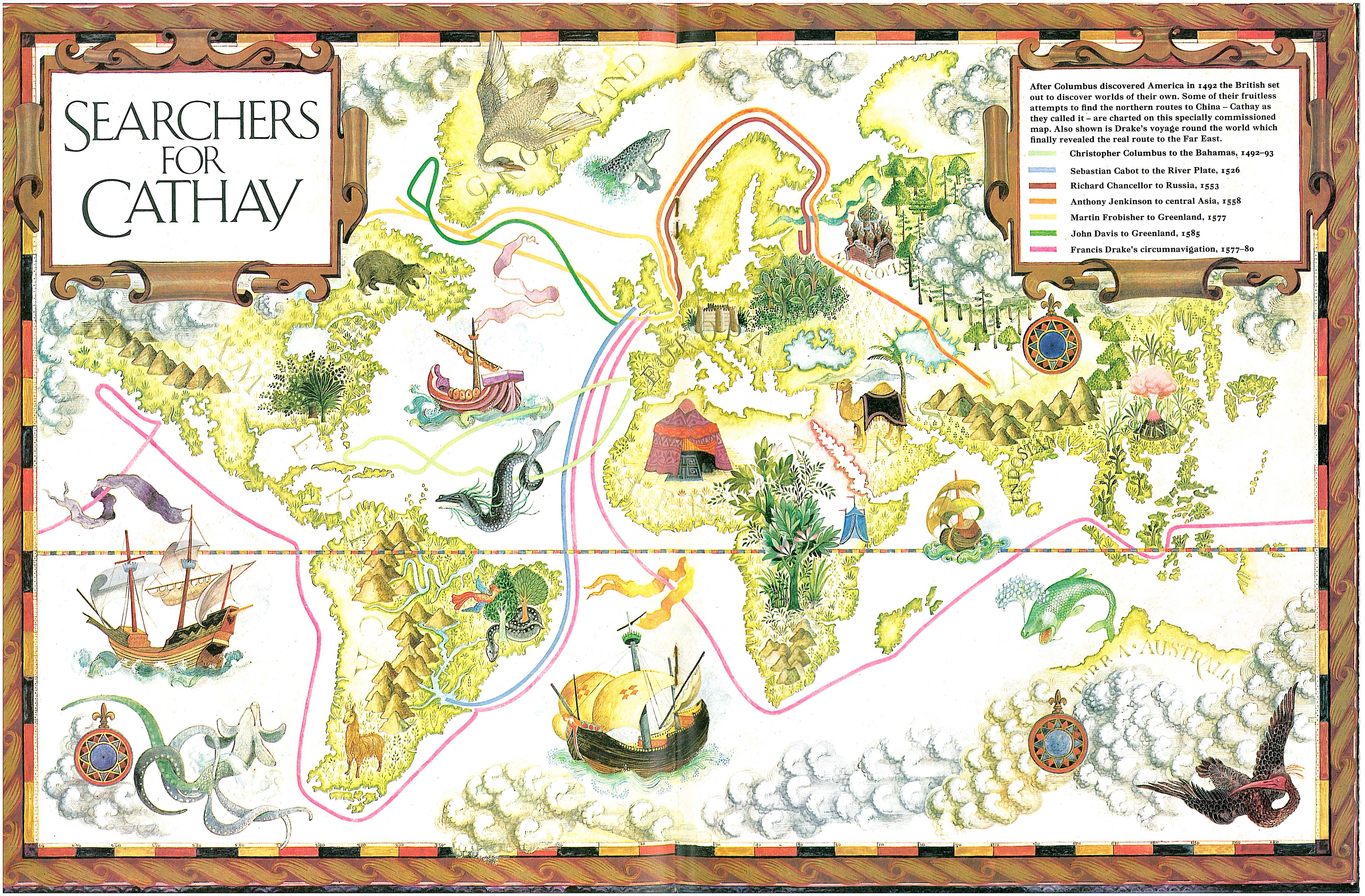
The search for a link with Cathay
continued. The Company's agent,
Anthony Jenkinson, journeyed in 1558/59
from Moscow to the Caspian and
thence worked his way to Bokhara, but
the silk caravans which had trekked
3,000 miles to China in the days of
Kublai Khan had long since ceased, and
anarchy prevailed throughout Turkestan.
Jenkinson headed next into Persia, reaching
Derbent in 1562, where he hoped to
establish a link with the Orient through
Persian middlemen. Prospects of trade
with the Far East proved disappointing,
but London merchants were soon exchanging
English woollens for ornate Persian carpets.
Frustrated by land, the Merchant
Adventurers, who rapidly acquired the
name of the "Muscovy Company," continued
their search by sea. Stephen
Borough in the Searchthrift, a tiny pinnace
manned by a crew of eight, managed
to push his way into the Kara Sea in
quest of Cape Tabin, a promontory
whose existence was predicted with certainty
by Dr. John Dee - mathematician,
geographer and unswerving believer in
magic - but which always remained lost
in the impenetrable fog and ice of the
Arctic. If only Tabin could be rounded,
then, according to the experts, the
Siberian coast sloped south-east to China
and the sailing would be easy. Borough's
attempt was so harrowing that it was not until 1580 that Arthur Pet and
Charles Jackman responded again to
Dr. Dee's continued urging to challenge
the Kara Sea. Pet made it back, but
Jackman and all his crew disappeared
without trace somewhere off the Norwegian
coast.
If not north-east, then north-west; if
Cape Tabin proved elusive in the Siberian
cold, perhaps Cabot's Straits and the
Broken Lands just north of Hudson Bay
might prove more attainable, for they
were well known "to such as have any
skill in geography," especially the remarkable
Dr. Dee. Moreover, the Muscovy
Company's charter did not limit the
prospects of "lands unknown" to the
north-east; the Company had a monopoly
in the west as well, and the desire to sell
English cloth was insatiable.
The arguments were powerfully expressed
by the adventurous but ill starred
Sir Humphrey Gilbert in an
enthusiastic little book: A Discourse of a
Discovery for a New Passage to Cathaia,
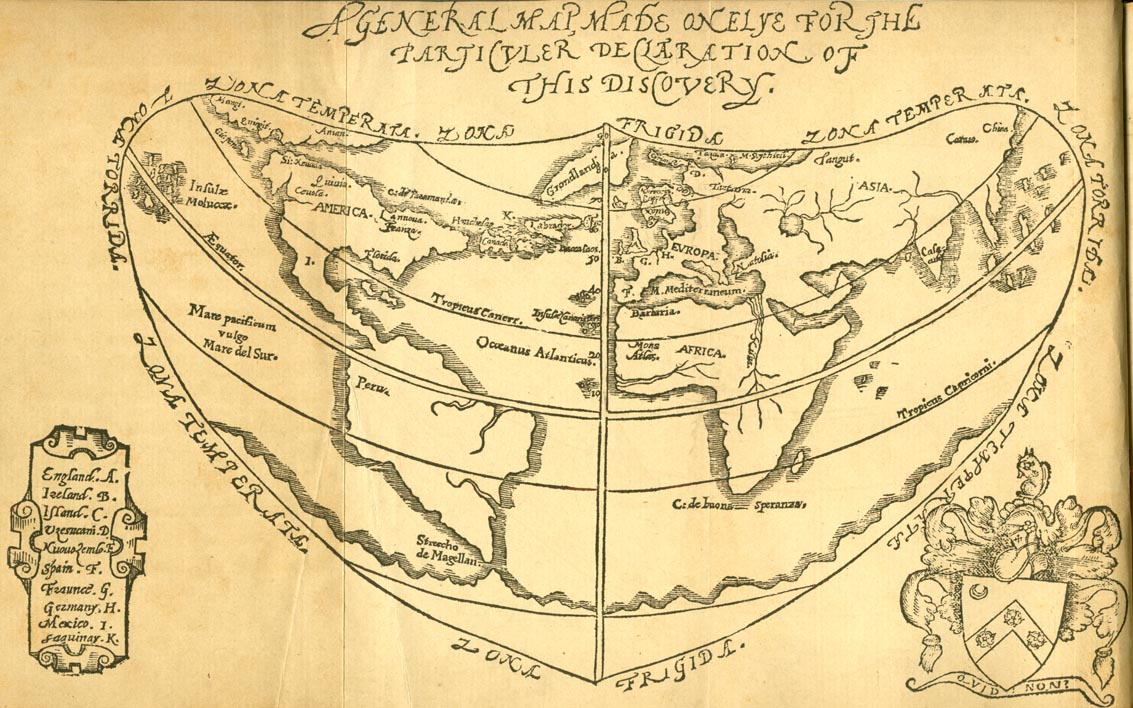
originally written in 1566. He concluded:
"that there lieth a great sea between it
[America], Cathaia and Greenland, by
the which any man of our country that
will give the attempt may with small
danger pass to Cathaia ... in much shorter
time than the Spaniard or Portugal."
With further stimulus provided by the
ambitions of a rather unsavoury master mariner and ex-pirate by the name of
Martin Frobisher, three small ships,
weighing only 60 tons in all, were fitted
out to test Dr. Dee's theories that a link
between the Atlantic and Pacific existed
somewhere north of latitude 60 degrees. On
June 8, 1576, the Gabriel, the Michael
and a ten-ton pinnace sailed past Greenwich
Palace and headed north for the
Greenland coast.
At first it appeared as if Frobisher
would follow Chancellor to a watery
grave, for the pinnace sank with all
hands in a raging storm and the Michael
conveyed itself "privily away" and ran
for home, reporting that Frobisher in the
Gabriel had been "cast away." The commander,
however, was not so easily
disposed of. He might have little understanding
of the theories that had inspired
his voyage, but a broken topmast
and a leaking ship could not stop an old
pirate from adding his name to the growing geography of the day. He sailed
on and discovered "Frobisher's Straits."
The name had to be changed to "Frobisher's
Bay" when it was discerned that
the stretch of water led only to the interior
of Baffin Island, but the Captain was
convinced that he had succeeded in his
mission. After all, the area was populated
by a race of slant-eyed Mongolian people
who seemed friendly, and certainly the
climate was cold enough to warrant any
number of English woollens.
And so Martin Frobisher returned to
London with the good news of his discovery,
one kidnapped native to prove
his claim, and a small piece of black rock.
Not everyone aboard the Gabriel had
been so fortunate; five of the crew had
placed too much faith in the friendliness
of the shy and childish Eskimos and had
been eaten for their confidence. The trip,
however, was proclaimed a triumph,
especially when it was rumoured that the
bit of black rock was gold ore.
The next year merchant-shipowner
Michael Lok and Frobisher had no trouble
in raising money and the short-lived
Company of Cathay was founded - not
so much in the expectation that China
was just over the north-western horizon
as that gold was to be had in the Arctic
regions. Even the Queen took the bait and invested over 2,000 pounds in two voyages
which brought back 1,500 tons of rock,
all of which turned out to be "fool's gold"
and quartz. Elizabeth burnt her fingers;
Lok ended up in debtor's prison; Frobisher
was once again called a pirate and a rascal;
and the fabled riches of Cathay remained
as far away as ever.
Dreamers like the Cabots, vendors of
black magic like Dr. Dee, and crude
opportunists like Frobisher, all had
been called by the North-West Passage
and had been turned back by cold and
ice. Now came the turn of a new type,
the "scientific navigator." Mr. John
Davis was the author of two books The
World's Hydrographical Description,
a defence of the Passage, and The Seaman's
Secrets, a handbook of navigation - and
he was a leader and organizer of dedication
and intellectual calibre.
His appearance on the oceanic scene
was symptomatic of the fact that the
energy and commitment which under the
early Tudors had been directed towards
the solution of domestic problems was
now turned to the greater world without.
Three generations earlier Englishmen
had been novices in navigation - even as
late as 1576 Martin Frobisher was sailing
more by guts and good luck than by
triangulation and exact compass bearings - but by 1580 Elizabethans were among
the best sailors in the world and John
Davis was in part responsible; he invented
a quadrant which for the first
time enabled mariners to locate their
latitude with precision.
There were other symptoms, too, of
the new outward urge in Davis's expedition.
A century before, a great cloth
magnate, Mr. Thomas Paycocke of Coggeshall,
had donated the proceeds of his
trade to found no more than a chantry to
sing Masses for his commercial soul; now
Mr. William Sanderson, of London, invested
the profits of his fishmongering to
buy Davis two fragile ships - the Sunshine
and the Moonshine - to carry him
over the top of the earth.
Once English Protestantism had been on the defensive now the
Queen's own Principal Secretary,
Sir Francis Walsingham,
was urging Davis to "attempt
that which God Himself hath appointed to
be performed" - the spreading of the light
of the Gospel into the Arctic unknown.
Three times, in 1585, 1586 and 1587,
Davis sought to "see the end of this
business," and he reached latitude 73 degrees
north, further than any Englishman had
penetrated. He gave his name to Davis Strait and christened the northernmost
point that he reached on the Greenland
coast "Sanderson's Hope," but no matter
how far he went, open water extended
further northward. We know today that
Cabot, Davis and Dee were correct in
theory: the polar route runs from Baffin
Bay into the Arctic Ocean and out again
through the Bering Strait, but it takes an
atomic submarine or a powerful icebreaking
oil-tanker to do it, not a 50-ton
cockleshell.
Sanderson's hope was never realized.
Though the East India Company sent
George Waymouth in 1602 into Arctic
waters just to be sure that the long
southern route round the Cape of Good
Hope was the only practical opening to
the East, and eight years later Henry
Hudson discovered at the cost of his life
the true geography of Hudson Bay, the
quest for Cathay in northern latitudes
really ended with John Davis's third
endeavour of 1587. There was no fourth
or fifth trip; the very dynamism that had
sent Davis to the top of the globe now
prevented him from seeing the business
finished, for England was headed for a
showdown with Spain. The year of the
Armada had arrived, and Raleigh's words
- "whosoever commands the trade of
the world commands the... world itself" - were being tested not in the north but
south-west in the Caribbean and southeast
in the Indian Ocean, where the riches
of the China trade were to be tapped.
These had become the focal points of
English expansion, the next arena in
which the Elizabethan heroes were to
display their boundless energy.
It was indeed an age of heroes,
answering to none. One and all they
were willing to "pay nature's debt
with cheerful countenance," for they
courted death and never feared it.
Within their souls there burned an awe inspiring
sense of election, but these
chosen few were no empty vessels filled
with the spirit of the Lord. The dynamism
that urged them on was devoid of
heavenly reward or hellish punishment.
They required of God only that He grant
them the chance to show their true metal,
forged in the fire of their egotism. The
adventure of life, said Raleigh to his son,
was "a troublesome bark," and it was up
to each man to make good his "station in
the upper deck; those that live under hatches are ordained to be drudges and
slaves."
Whatever may be said against these
heroes of Elizabethan England, they cannot
be accused of dullness or slavishness.
They spoke proudly and persistently of
their duty to God and Queen, but
Elizabeth knew that neither the threat
of prison nor the fear of hell could
discipline her warriors, and, in letter after
letter, she was reduced to impotent
rage and helpless pleading. Duty to
themselves as a breed of men apart was
the root and branch of their faith.
Such attitudes were part of the flavour
and proportions of the age. Not only did
Gilbert, Raleigh, Drake and the rest take
themselves and their reputations seriously
but so also did the world in which they
lived. Drake's ruddy and belligerent
features and tub-like frame hung in the
portrait galleries of innumerable Protestant
princes throughout Germany and
Holland; the daredevil death at the age of
32 of Sir Philip Sidney, who rode into
battle without his leg armour because
his wounded commander was unable to wear armour, was held up as an act of
daring and renown becoming a great poet;
and Marlowe spoke for his generation
when he wrote of the dreadful Tamburlaine
that his honour consisted "in
shedding blood."
The heroes of the 16th Century were
no deities fulfilling their boisterous destinies
in Olympian isolation, nor were they
exceptions to the Tudor rule; they were
simply magnified examples of it. Individually
their actions may seem grotesque, but
placed within the context of an age
where exaggeration and violence were the
central characteristics of life, their feats
become no more extraordinary than that
of the indefatigable Robert Carey, who
won a 2,000 pound bet by walking from London
to Berwick in 12 days, or that of the unnamed
English soldier whose arm was
shot off by a cannon-ball at the siege of
Ostend. Nothing daunted, the young
man picked up the severed limb, returned
with it to camp and announced to his
comrades: "Behold the arm which but
at dinner helped its fellow." The 16th
Century, as did the 18th, believed in "bottom," the untranslatable word which
united stoicism with enthusiasm, histrionics
with conviction, and foppery
with toughness.
Their feats should be placed within the
context of an age where exaggeration and
violence were the central characteristics
of life. Imagine life as it actually was - a
long agony of itches from skin diseases,
lice and fleas, a steady procession of
toothaches, gout, stones, rheumatism and
pains, and the constant fear of smallpox,
sweating sickness and the plague. Only
the strong of body and stout of heart
survived, and even they could not long
withstand medical practices designed
more to test the patient's fortitude than
to cure his sickness. The surgeon's saw
without ether, the barber's tooth extractor
without novocaine, and the
physician's potions without understanding,
were no less terrible than
Spanish musket and cannon shot.
Men wore a tough hide of inhumanity
and callousness that inured them to the
sight of blind beggars trying to club a
pig to death, or to the agonies of the
condemned prisoner writhing in a pot of boiling oil, of the witch suffering on the
stake, and of the traitor strung up on the
gallows and then, still living, cut down,
castrated and disembowelled.
This callousness was often reflected in
the behaviour of the Elizabethan hero adventurers.
The picture of Sir Francis
Drake sitting cross-legged on a sea-chest
and enjoying himself hugely while lecturing
his delinquent chaplain, who was
chained and collared to the deck in front
of him, is an example of ruthlessness and
egotism unforgivable even in a demigod.
The unfortunate Francis
Fletcher had spoken disrespectfully
and ill-advisedly of
his Captain and had intimated
that the misfortunes of the
Golden Hind had come as retribution for
Drake's execution of one Thomas Doughty
for witchery and disobedience. Sir
Francis' simple Puritan soul was outraged
by this fearful evidence that Satan
had entered even into the heart of a
minister of God, and calling his crew
together he addressed the frightened and
humiliated clergyman: "Francis Fletcher, I do here excommunicate thee out of the
Church of God and from all benefits and
graces thereof, and I denounce thee to the
devil and all his angels."
In judging Drake's sadistic satisfaction,
it is well to remember that cruelty
gave spice to life.
Man's fate on earth was boredom, pain
and death, and those who endured it demanded
the chance to enjoy life vicariously.
They thrilled at Raleigh's boast
that England would make the kings of
Spain "kings of figs and oranges, as in
old times" for such words lent verisimilitude
to their dreams. Gilded youths
with "fierce dragons' spleens," wearing a
lord's revenue on their backs, and buccaneers
who were mindful only of the
vainglory of life must have been irritating
beyond measure - to the merchant immersed
in his accounts, to the bureaucrat
insensible of romance, and to a Queen
who counted her change and constantly
inquired into the cost of glory. The 16th
Century, however, forgave them because
they were great. never more so than when
they challenged the unknown for the sake
of fame and, they fondly hoped, wealth.
|
|
The Diabolical Doctor Dee
|
|
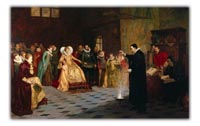
Among the founders of the British
Empire, none was more bizarre than the
brilliant Cambridge educated John
Dee. Mathematician and sorcerer, astronomer
and alchemist, geographer and
astrologer, he was acknowledged as
England's greatest authority on the
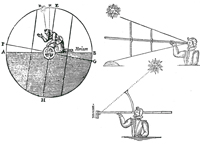
mathematics of navigation, introduced
the cross-staff from Europe and inspired generations of
grizzled navigators to roll back the
frontiers of the known world.
He was held in great esteem by such
sea-dogs as Drake, Davis and Frobisher,
who eagerly sought his advice and
hungrily devoured his output of maps,
technical handbooks and navigational
essays. But Dee's geography was essentially
speculative. He was a firm believer
in the fabled southern continent
which was said to lie in the Pacific to
counter-balance the weight of the northern
land-masses, and staunchly supported
the theory that there was a
navigable North-East Passage to China.
The Doctor was, however, more than
theorist and scientist: he also had a
credulous faith in the powers of alchemy
and sorcery. For years he struggled
to transform base metals into gold and
discover the elixir of life. He firmly
believed he could use "impious and damnable
magick" to conjure infernal spirits
who would impart all knowledge and
power. Many, indeed, thought that, like
Marlowe's Dr. Faustus, Dee had made
a pact with the Devil in return for the
services of demons.
Elizabeth, like most of her countrymen,
took such powers seriously: she
appointed him Royal Adviser on Mystic
Secrets and loved to visit him in his
Thames-side house at Mortlake to discuss
astrology.
Tragically, his contributions to English
expansion were soon forgotten and
he died in abject poverty, aged 81, still
mesmerized by the gobbledegook of
medieval "science." Yet in one way, he
was the greatest visionary of Tudor
England: long before it became a
reality, he was talking confidently about
a "British Empire" and hustling off
navigators to claim it.
|
|
The New World and Beyond
|
|
While the Muscovy Company's
sailors fought their
way to a standstill in the
Arctic wastes, others tackled
different routes to the
East with more success: overland through
the Middle East, south-east round the
Cape of Good Hope and south-west
round Cape Horn.
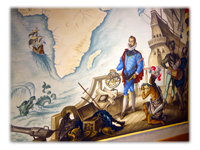
Of all the voyages which at this time
jolted England out of her insularity, Sir
Francis Drake's epic and piratical circumnavigation
of the globe via the Horn
was the most awe-inspiring. Drake's
achievement, even more than the victory
over the Armada, produced the marvellous
confidence that led Raleigh to exclaim:
"What shall we be, travellers or tinkers?
conquerors or novices?"; and it clearly
demonstrated that the oceans were no
longer closed Iberian preserves but open
to all strong enough to sail them.
The expedition was pure magic. It
began on December 13, 1577, and lasted
nearly three years. On September 6, 1578,
Captain Francis Drake in the Golden Hind
sailed out of the windswept Straits of
Magellan, headed up the South American
coast "liberating" the treasures of Spain
as he went, travelled as far north as
British Columbia in search of the entrance
to the North-West Passage, doubled
back to California and on June 17, 1579,
took formal possession of the shores of
San Francisco Bay for his Queen. Four
months later he was in the Philippines,
and on November 3 he anchored off the
most valuable real estate in the world,
the spice islands of the Moluccas where
the precious clove grew. Soon the indefatigable
Captain was delighting the
Sultan of Ternate with Elizabethan music
and had persuaded him to place the
entire spice trade in English hands.
The Golden Hind took on a cargo of
six tons of cloves, which were fetching
five shillings a pound on the European
market, and II months and a shipwreck
later, Drake sailed into Plymouth Harbour.
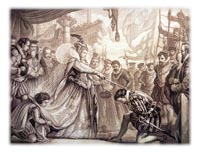
It was not the New Albion of
California which impressed Elizabeth
when Drake finally arrived home but
those East Indian cloves, and when she
rewarded her Captain with a silver
goblet, she had the cup engraved with a
picture of Sir Francis being received by
the Sultan of Ternate. At last an English-man had tapped the treasures of the
Indies and approached Cathay.
 |
|
|
The Pacific route proved to be an
eternity. The passage through the Straits
of Magellan alone was a desperate feat.
Edward Fenton in 1582 never made it,
Thomas Cavendish in 1586 took 49 days
on his first endeavour and gave up
entirely on his second, and Richard
Hawkins in 1593 managed the trip in 46
days. At every step of the way there was
danger - storm, mutiny, shipwreck and
Spanish reprisal. Thomas Cavendish died
while at sea; John Davis crept back
with 16 of an original crew of 67; Richard
Hawkins spent eight years in foreign
jails; from John Childley's and Andrew
Myrick's ill-starred efforts only four
Englishmen out of 300 returned home.
But Drake, even after he had jettisoned
half the cargo to save his ship, had made
such a gigantic profit that it was more
than enough to blind anyone to the
horrors of the Horn.
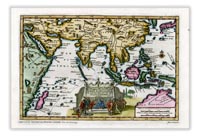
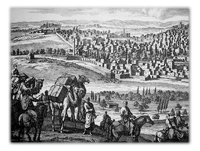
The second alternative to the
northern path to the Orient
- by way of the eastern Mediterranean
- was the oldest and
shortest tie between East and
West but tortuous beyond description.
Chinese silk and East Indian spices were
gathered at the thriving Indian ports on
the Malabar coast; thence they were
carried in clumsy ocean-going baghlas to
the entrance of the Persian Gulf and reshipped
by frail coastal vessels to Basra,
where the precious cargo was again
unloaded and transported by camel caravan
to Aleppo and finally to the port of
Tripoli. From the bazaars of the Levant
they found their way via Italian middlemen
to every city of Europe. The risks
were incalculable but such was the value
of the cloves and nutmeg, silks and sandalwood
that a handsome profit was realized
if only one shipment in six got through.
 |
|
|
During the I570s London merchants
had turned to the Levant as the only
practical link with the Orient since
Iberian naval power still dominated the
ocean-routes. Special trading rights were
secured from the Turkish Sultan by time honoured
means: egregious flattery and
the gift of a mechanical clock of extraordinary
ingenuity. By 1579 the Levant
Company was in business. Despite Muslim piracy and Spanish naval guns in the
Mediterranean, it was soon a thriving
financial success.
Elizabethans, as usual, were greedy
and not content with a transhipment
trade in which the real profits went to
Turkish and Venetian entrepreneurs,
and in 1583 John Newberry and four
colleagues journeyed from Aleppo to
Baghdad and Basra in an effort to trade
directly with the Orient. From Basra,
Newberry and three others sailed on to
India where, after adventures which
belong more to The Arabian Nights than
to real life, three of the travellers found
themselves at the Court of the great
Akbar to whom they presented the
ornate and wordy greetings of their
Queen. William Leeds, an expert in fine
jewels, was induced to remain at Agra;
Ralph Fitch headed further east into the
Ganges delta, trading the whole way; and
Newberry, convinced that only a sea route
round the Cape of Good Hope
could successfully tap the riches of India,
started home to report his findings, only
to vanish somewhere in the barren expanse
of central Asia. Fitch kept going,
studying commercial possibilities in Siam
and Burma, spying on Portuguese trading
posts in the East Indies and eventually
retracing his steps to Basra and finally
Aleppo. He returned home in April, 1591,
after eight years of wandering to discover
his estates probated and a memorial
service long since offered for his perambulating,
soul.
 |
|
|
Only one other sea-link to China
existed and that was almost as dangerous
as the Straits of Magellan. The passage
south round the Cape of Good Hope meant a three-month journey before the
first landfall, after which most available
watering-points were controlled by the
Portuguese. But following the triumph
over the Armada, Elizabethans were
keen to try. The Dutch were already
setting the pace, plundering Portuguese
merchantmen as they sailed from Goa and
Malacca for Lisbon. No one in England
could forget the riches of the San Felipe,
a vast East Indian carrack taken by
Drake in 1587 and valued at 108,000 pounds, or
the Madre de Dios worth 140,000 pounds, or all
the other 1,000-ton carracks which the
Portuguese used to solve the logistical
problem of carrying enough supplies to
round the Cape.
The first English expedition set sail in
April, 1591 - the month Ralph Fitch
returned to life. Humanly, financially and
commercially the voyage was a fiasco,
a sad log of mutiny, shipwreck, piracy,
Portuguese attacks, marooning and starvation,
and only Captain James Lancaster
and 12 of his men made it home, without
ships or profit. In 1595 Captain
Benjamin Wood tried his luck; all three
of his ships, the Bear, the Bear's Whelp
and the Benjamin, were lost and not an
Englishman survived.
Avarice and adventure proved stronger
than failure. On the last day of the
century, a group of London merchants
received the Queen's grant to form the Honourable East India Company, and a
year and a half later four tall vessels
sailed from Torbay for points east.
James Lancaster was again Captain,
James Davis his Chief Pilot and Ralph
Fitch, his estates returned to him, was
one of the subscribers. Combining trade
and piracy, the fleet co-operated with the
Dutch in seizing an immensely valuable
Portuguese Indiaman, and then established
a small English trading post at
Bantam in Java. By September, 1603,
Lancaster was home again with all his
ships, half his crew alive and a handsome
profit for the 24 directors and 218 subscribers
of the Company, who had invested
50 pounds apiece in the venture.
Lancaster earned himself a knighthood,
but sensibly stayed at home the
following year, when the second of the
Company's fleets sailed under Captain
Henry Middleton. This time the cost
was higher - one ship, a larger percentage
of the crew dead, and a head-on collision
with the Dutch, who were effectively
taking over the East Indies and were just
as unwilling as the Portuguese to share
the spice trade.
To avoid the Dutch the Honourable
Directors on their third gamble sent
William Keeling to India and the Court
of the Mughal Emperor at Agra, in the
hope of opening the Indian continent to
English trade. Captain Keeling liked to keep his crew healthy on lime-juice and
happy on Shakespeare, and he induced
his ragged and illiterate men to memorize
Hamlet and Richard II; when his fleet
anchored off the coast of Sierre Leone,
the two plays were produced before an
audience of enthusiastic if mystified
natives. Anglo-Saxon culture had become
a commodity for export; England
had indeed turned outward!
The confidence in things English
that induced Keeling to
cram Hamlet down the throats of
his crew, the sublime arrogance
that led Thomas Cavendish to
assume that the oceans of the world
belonged to his Queen, "the most famous
and victorious prince that liveth in the
world," now led others to imagine a new
England beyond the sea, a plantation
complete with women and children to
sing the Lord's praises and recite with
Hamlet: "There's a divinity that shapes
our ends, rough-hew them how we will."
Of all the maritime powers of the
16th Century only England succeeded in
planting living replicas of herself in the
wilderness. Castilians by the thousands
went forth to conquer, convert , even to
marry and settle in the New World, but
they carved out a subjugated empire, not
a new Spain. Frenchmen crossed the
ocean to hunt, trap and negotiate with the
Canadian Indians, but they returned to
their Gallic paradise as soon as they
could. Only the English created a new
England, settled not by subjects of the
Crown resolved to live beyond the seas
but by pioneers and builders in a land of
new promise, who soon learned that
loyalty belongs "where the heart and
blood are given."
The changeover from woollens to men
as England's most valuable export did not
come easily. In a way, it was a partial
confession that the search for Cathay had
failed and that Elizabethans would have
to look elsewhere. for "gold, for praise, for
glory." Englishmen had to be taught a
new vision, and that was the achievement
of three men, Richard Hakluyt, Sir
Humphrey Gilbert and Sir Walter Raleigh.
Never was a triumvirate so incongruous.
Hakluyt was a Hertfordshire cleric and
scholar whose maritime experience included
nothing more exciting than a
Channel crossing but whose delight in "cosmographie" was so prodigious that
he edited 1,700,000 words worth of travel
stories; Gilbert was a West Country
squire who fancied himself the instrument
of God's ultimate design on earth;
and Raleigh was a brilliant courtier whose
rapier tongue gave "the lie" even to the
Court which sustained him and whose
scornful genius antagonized everyone
save the Queen. But the three were alike
in their determination to discover a new
kind of Cathay - an El Dorado which
could be all things to all men, whether
they were plunderers or settlers, adventurers
or dreamers.
 |
|
|
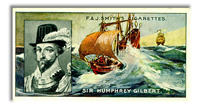
Sir Humphrey Gilbert, that worthy
Devonian product of Eton and Oxford,
was the first to be sacrificed to the
vision of a new nation. In 1583 he sailed
for Newfoundland with five ships and 260
colonists to establish a bridgehead on the other side of the ocean. The entire venture
was a study in contrast: detailed,
long-range, practical planning versus
petty selfishness, maddening overconfidence
and fatal irresponsibility. On
board were shipwrights and carpenters,
blacksmiths and miners. There were toys
for the "allurement of the savages," an
official historian and even a ship's poet
who wrote The Embarkation Ode; but
half the crew were ex-Channel pirates
and, to make matters worse, not a
woman sailed with the fleet.
Two days out the trouble began; the
best ship of the flotilla deserted and beat
back to home. Then the crew of the
Swallow locked their Captain in his cabin
and indulged in a week of pirating among
the barks and fishing skiffs off the Grand
Banks. After seven weeks the fleet
reached St. John's, where 36 fishing vessels of various nationalities were drying
their catch. Sir Humphrey immediately
declared himself Governor and took
possession of the whole island in the
name of the Queen. His authority, alas,
extended no further than his voice, and
despite a splendid proclamation announcing
that all religious services were to be
Church of England, that English justice
would henceforth prevail and that anyone
dishonouring Elizabeth's name would
lose his ears, the colony distintegrated
the moment Englishmen set foot ashore.
They mutinied, they stole, they deserted
and they demanded to be sent home when it became clear that there was cod
aplenty but no gold - or any other precious
metal to be found.
Sir Humphrey, however, would not
give up. He sent the sick, the mutinous
and the disenchanted home on the
Swallow and headed his three remaining
ships toward Nova Scotia in search of
new lands and a more permanent abode.
Off Cape Race the ultimate disaster
occurred. The Delight was driven ashore
and 100 colonists with all the fleet's provisions
were lost. God's hand was evident,
and there was nothing left except to
creep home, the expedition a total failure and Sir Humphrey close to bankruptcy.
From the start Gilbert had proved an
impossible commander - mulish, impetuous
and complacently self-confident
- but those very qualities now transformed
ignominious failure into immortal
legend. Disdaining to leave the overcrowded
and cramped ten-ton Squirrel
for the larger and safer Golden Hind, Sir
Humphrey deliberately courted disaster,
preferring "the wind of a vain report to
the weight of his own life." Nemesis overtook
him on the night of September 9
when the Squirrel was "devoured and
swallowed up in the sea." That extraordinary
man, part fool, part fanatic,
part hero, had followed his own words
to the end: "We are as near to heaven by
sea as by land."
Colonization ran in the blood, and the
following year Gilbert's half-brother, Sir
Waiter Raleigh, took up where Sir
Humphrey had left off.
As in everything he did, Raleigh set about the business with magnificent style, and in March, 1584,
he received one of those
delightfully optimistic documents
from his Sovereign empowering
him to "discover barbarous countries"
and "occupy and enjoy the same forever ."
After a year of reconnaissance to locate
a site far enough south to be temperate
but far enough north to be safe from the
Spanish, Sir WaIter was ready to set
sail.
Raleigh sought to lead the expedition
in person but at the last moment had to
relinquish command to his daredevil
cousin, Sir Richard Grenville, who convoyed
108 adventurers - including an
artist, John White - in ten
small ships to the Carolina coast.
The colonists made an impressive
group: Sir Richard himself, the seaman
who would soon make naval history
with his gallant single-ship fight
against an entire Spanish flotilla; Thomas
Cavendish, the future circumnavigator of
the earth, John White, artist and observer,
Thomas Hariot; botanist, mathematician
and author. But gentlemen
adventurers, naval heroes, watercolourists
and scientists were not sufficient
to sustain a colony, even in a land
"the most plentiful, sweet, fruitful and
wholesome in the whole world."
|
|
Richard Hakluyt, Apostle of Empire
|
|
Richard Hakluyt was the most influential
of the select band of literary Elizabethans
who - like Gilbert, Davis, Dee
and Raleigh - publicized their vision of
a greater England beyond the seas.
Inspired as a schoolboy by his geographically
minded cousin - also named
Richard Hakluyt - he dedicated his life
to recording voyages and exhorting his
countrymen to enterprise overseas.
First, with a prophetic enthusiasm for
the future direction of imperial expansion,
he propagandized for colonization
in North America.
Then, while acting as Chaplain to the
English Embassy in Paris in 1583, he
learned that the English were held in
contempt on the Continent for their
"sluggish security." Incensed, he set
about his major work: to record every
voyage of exploration and settlement.
undertaken by Englishmen as a way of
pushing them on to yet greater achievement.
To this end, he sought the friendship
of the "chiefest Captains, the
greatest Merchants, and the best Mariners."
He read everything he could lay
his hands on. He had works translated,
and translated others himself. He inspired
a generation of Oxford undergraduates
with his brilliant lectures.
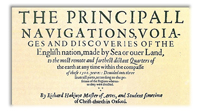
The first edition of Principal Navigations and Discoveries of the English Nation at 700,000 words appeared
in 1589. But in the next decade, English explorers proved so ambitious that the work was soon out of date. Nothing
daunted the indefatigable author set
about adding another million words,
and the second edition appeared at the
end of the century.
It remains a unique work, a combination
of pithy narrative, history,
diplomacy and economics, welded together
by a towering historical vision
and unrivalled accuracy into "the prose
epic of the modern English nation."
To Hakluyt, we owe practically everything
we know about many English
voyages - the travels of Newberry and
Fitch in Asia, of Lancaster in the East
Indies, of Raleigh to Virginia and South
America. He records delightful human
touches, like the "Morris dancers, Hobby
horse and Manylike conceits" taken by
Gilbert on his last voyage "to delight the
Savage people."
His arguments, too, were persuasive to
Elizabethan readers: colonies, he said,
would "vent" England's excess population,
especially the unemployed and
criminals; they would be sources of
untold wealth; they would be strategically
vital in struggles with other powers.
His was a heroic, optimistic vision yet
over the next three centuries his
dreams were more than fulfilled and his
work remained the epic inspiration
which he had intended.
|
|
The Birth of Greater Britain
|
|
Grenville's expedition to America
suffered from all the failings
that had plagued Gilbert opportunism,
lack of discipline
and light-hearted disregard for
the realities of successful
colonization.
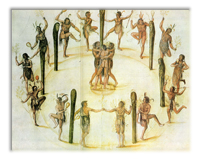
They were at first "well entertayned
by the Savages," but shortly after their
arrival Grenville committed an act of
folly which shattered the friendly relations
with the Indians. A silver cup had
disappeared. Grenville assumed it had
been stolen by the Indians and laid waste
one of their villages. Soon afterwards, he
sailed for home, promising to return with
a new batch of recruits.
 |
|
|
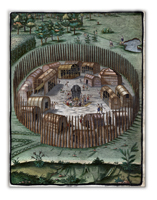
The settlers were left on their own.
Shortage of food, the prospect of backbreaking
labour and fear of the Indians .
reduced the tiny social organism to a
mob of hysterical men. They never seemed
able to feed themselves properly, and
their initial good reception led them to
place far too much reliance on continuing
Indian goodwill. Disillusion on both sides
led to increasing bitterness and finally to
a pre-emptive British attack on an Indian
village. Had war continued, the British
would have had no hope, but providentially,
a week after the attack, a sail was
sighted. It was not the return of Grenville
- he had delayed to do a little
buccaneering on the way - but a chance
visit by Drake, who offered the settlers
passage back to the Old World. All but 15
of them bolted for home.
Sir Walter had lost a fortune, but he
and Grenville had received a valuable
warning: the launching of a living organism
takes more than promotional literature
and the dream of Empire; it involves
money, organization and, above all, men
and women with the conviction and staying
power to work the rich soil and create
a new way of life 3,000 miles from home.
Recruiting was all important, and on his
second attempt Raleigh offered 150 pioneers
500 acres apiece and a voice in their
own government if they dared leave the
safety of their firesides and establish a
settlement in the New World. The colonists,
under the governorship of John
White, arrived at Roanoke Island in
July, 1587, and found nothing except the
bones of one of the 15 volunteers left
behind after the flight of the first settlers.
Nevertheless, the pioneers elected to make their new home on the ruins of the
abandoned old one.
The decision was fatal, for the Indians
had neither forgiven nor forgotten the
brutality and high-handedness of the
earlier colonists. Three weeks after
the settlers' arrival, Indians surprised
and killed one of the men who was fishing
for two miles away from the village.
White tried to arrange a meeting with the
Indians to patch up their differences. The
Indians did not arrive. His patience at an
end, White assaulted an Indian village.
For a brief moment it looked as if the
colony might survive - a child was born
to Eleanor and Ananias Dare - but soon
nerves began to falter and the settlers
insisted that John White return to
England with a frantic appeal for more
spades, more axes, more seeds and more
of the necessities of civilization which
might save them from extinction.
Four years passed before White again
set foot on Roanoke Island. He returned
on August 18, 1591, after dark. "We let
fall our Grapnel neere the shore, and
sounded with a trumpet a Call, and afterwardes
many familiar English tunes of
Songs, and called to them friendly; but had no answere." There never was an
answer. Every last soul had vanished in
one of history's greatest mysteries.
There had been a prearranged signal in
case of danger. A Maltese cross was to be
cut in the wood of the stockade and a sign
carved to indicate what had happened.
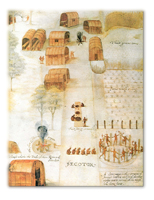
No cross was ever discovered, but on a
tree was carved the enigmatic message,
"CRO." "in fine Romane letters." Inland,
White and his men found the overgrown
ruins of the settlers' fort and houses. On a
post by the entrance to the village was
carved the word "Croatoan." On the
shore, they found five chests, previously
buried by the settlers, now dug up and
broken open. Three were White's: his
books had been torn apart and his
armour was rusted through.
 |
|
|
Had the settlers gone to live with the
Croatoan Indians, had they been massacred
by them, or had something else
happened? All that survived of the lost
colony was the legend of a breed of white faced,
blue-eyed Indians somewhere in
the interior.
The Roanoke settlement may have
been martyred to the savagery of a new
continent but it was also one of the first victims of the Armada, for when John
White sailed back to England in 1587 he
found the kingdom on the verge of war
with Spain. Raleigh had already invested
40,000 pounds and it took months to find
new capital and supplies. Then, just as
Grenville succeeded in gathering together
a relief party, news of the Armada's
sailing arrived, and all Her Majesty's
vessels were commandeered for the defence
of the realm.
Consequently the remaining 89
men, 17 women and 1 children
of the Roanoke settlement
may have been sacrificed, but
essential lessons had been
learned. First, colonization was too expensive
for a single patron; it needed the
same kind of group financing and unofficial
state support given the Muscovy
Company and the East India Company.
Second, El Dorado was a figment. There
was no way to a quick profit, only backbreaking
investment in a new nation; as
Francis Bacon said, the founding of
colonies was like the planting of trees:
"you must make account to lose almost
twenty years' profit, and expect your
recompense in the end."
Raleigh appreciated the lesson; he was
too good a businessman and engineer not
to, but he was also a poet and a dreamer,
and he could not forget the vision of a
haven, devoid of human toil and suffering.
For a few an imaginary Cathay was
always just round the corner waiting to
be discovered, and early in 1595 Sir Walter sailed forth to seek his paradise in
the inaccessible reaches of the South
American Orinoco River where not even
a Spaniard had ever been.
With 100 men he began the long ordeal
of rowing up the Orinoco. He was forced
"to lie in the rain and weather, in the open
air, in the burning sun, and upon the
hard boards," and conditions became so
foul that "there was never any prison in
England that could be found more unsavoury
and loathsome." At 43, the
gallant Captain longed for the comforts
of a feather-bed and a decently cooked
meal, but his vision dispelled yearnings
for dry bedclothes and good food. He
continued on into the labyrinth of tributaries
that formed the Orinoco. Raleigh
found no golden cities, but he saw
wonders that inspired him, and made him
all the more willing to believe the fairytales
told by the Indians. Three hundred
miles inland he encountered "the most
beautiful country that ever mine eyes
beheld," a land rich in game and the fullness
of the earth, where every pebble
seemed to hold the promise of a fortune.
Only the ugly crocodiles that swam in the
wake of his ship, and to which one of his
company fell victim, marred what seemed
demi-paradise.
From the Indians, Raleigh learned of
wonders even more marvellous: of oysters
that grew on trees; of kings who clothed themselves in gold-dust; of giant men
called "Ewaipanoma" with mouths in
their chests and eyes in their shoulders;
and of Amazons who on the 12th month
of each year invited the lustiest warriors
of neighbouring tribes to stand on the
borders of their territories while the
damsels "cast lots for their valentines."
The ladies enjoyed their men until the
moon signified the end of a month of
feasting and love-making. No wonder
Guiana always remained for Raleigh "a
country that hath yet her maidenhead."
The rainy season came, and Sir WaIter's
little band decided that they had had
enough of hard boards and unsavoury
victuals. They returned to the ships in
the estuary and sailed back to England
with no gold in their pockets but with
visions of paradise in their heads.
It was this myth, this image of "a
shelter and a hiding place" in the New
World, whether in Massachusetts or
Virginia, Newfoundland or Guinea, that
kept Englishmen coming; and eventually
they succeeded in planting a new nation
beyond the sea.
Gilbert gave his life and Raleigh his
fortune and creative imagination to the
New World; Richard Hakluyt gave it his
pen and produced "the prose epic of the
modern English nation." As a young
Queen's Scholar at Westminster, Hakluyt
had been enthralled by maps and tales of oceanic travel, and as a clergyman
he became obsessed with an almost
divine calling - the duty to tell Elizabethans
that the seas were open to all
men of courage, that Cathay was within
reach and that North America must be
planted with Englishmen. He trained
himself in mathematics and geography
and mastered a half-dozen languages so
that not a single discovery or act of
heroism might escape his eye, and the
magic of his descriptions transmuted the
grim, sordid tales of freezing and cannibalism
into the pure gold of high
adventure.
Once started, English expansion could
not be stopped, and such was the pace of
adventure that within a decade a second
edition was needed to record it, a million
words heavier than the first. Richard
Hakluyt died in 16166; by then a new
dynasty sat upon the throne and Elizabeth's
sea-dogs were a mere memory, but
their epitaph had already been proudly
written: Englishmen "through the speccial assistance and blessing of God, in
searching the most opposite corners and
quarters of the world, and to speak
plainly, in compassing the vast globe of
the earth more than once, have excelled
all nations and peoples of the earth."
|
|
|